Showing posts with label cinema. Show all posts

Monday, July 20, 2020

Rogério Sganzerla &/or the most audacious Brazilian film maker after Glauber Rocha (+ Neville de Almeida: yes, there is such a body still in the world!)


Sem Essa, Aranha (Sganzerla/1970) + Navalha na Carne (Neville de Almeida/1997);
Death of Night (Alberto Cavalcanti, 1945);
Sem Essa, Aranha (trechos do filme, Sganzerla/1980);
Bonna Petit &/ou Helena Ignez Transcendental [I took this video out of Youtube, because I wanted to change it];
Realce (Gilberto Gil + Andrea Tonacci) [I took this video out of Youtube, because I wanted to change it];
Jardim de Guerra (Neville de Almeida, 1970);
A Dama do Lotação (Neville de Almeida, 1978); 
Rio Babilônia (Neville de Almeida, 1982); 
Navalha na Carne (O Brinde) (Neville de Almeida, 1997); 
Faca de Dois Gumes (Murilo Salles, 1989);
Exorcismo Negro (José Mojica Marins, 1974);  
Assalto ao Trem Pagador (Roberto Farias, 1962) [Youtube blocked the exhibition of this video];
**************************************************************

Commentary, scholium, illustration and key: 


"... the people who are very talented, but whose talents are hard to define and almost impossible to market. That was the 'staff' of Andy Warhol Enterprises... I didn't expect the movies we were doing to be commercial. It was enough that the art had gone into the stream of commerce, out into the real world."
Andy Warhol
"More and more I have the feeling that we are getting nowhere. Slowly, as the talk goes on, we are getting nowhere and that is a pleasure. It is not irritating to be where one is. It is only irritating to think one would like to be somewhere else."
John Cage (Lecture on Nothing)
"... art is a sort of experimental station in which one tries out living; one doesn't stop living when one is occupied making the art, and when one is living, that is, for example, now reading a lecture on something and nothing, one doesn't stop being occupied making the art..."
"... the movement with the wind of the Orient and the movement against the wind of the Occident meet in America and produce a movement upwards into the air..."
John Cage (Lecture on Something)

"The figures in the ISCM and the League were not powerful aesthetically, but powerful only politically."
John Cage (History of Experimental Music in the United States)
"J'emmerde l'Art."
Satie/Cage
"Un foco ilumina con ramalazo de aluminio las tres cuartas partes de su rostro, y el vértice de su córnea brilla más que el de un actor de cine."
Roberto Arlt

"Rogério tinha um cabelo Maracanã, se vestia muito mal. Então nós fomos a Nova York, compramos roupas fantásticas no Greenwich Village. Penteei Rogério. Eu acho fantástico. Um homem inteiramente sem personalidade na vida familiar e aquela pessoa ótima jogada pra fora. Acho genial."
"Minha família é da alta classe média baiana. A gente vê, não tenho mau gosto, me visto bem. Não sou nenhuma miserável da Bahia."
"Acho maravilhoso o Rogério perguntar o restaurante: 'o que é que eu vou comer?'... Essa dependência total que Rogério tem de mim é absolutamente maravilhosa. Porque é radical e total." 
Helena Ignez (Pasquim, 1970 — entrevista reproduzida na coletânea indicada abaixo)
"Acredito que o Kubrick, pelos resultados que a gente vê nos filmes dele, também [como o Rogério] deve ter essa magia, esse conhecimento profundo do que é e um respeito profundíssimo pelo trabalho do ator."
Helena Ignez (Entrevista para Alessandra Bastos, 2003)
"Es decir, los fanáticos sebastianistas quieren restaurar el Imperio, con ayuda del conde de  Eu, de los monárquicos, de Inglaterra y, por  supuesto, del  Partido  Autonomista de Bahía."
Barón Cañabrava (Mario Vargas Llosa, La guerra del fin del mundo)

"Considero A mulher de todos o maior filme que já vi no cinema brasileiro em todos os tempos."
"Helena Ignez colocou muito de sua linguagem em Cara a Cara, O Bandido da Luz Vermelha e A mulher de todos. Mas foi com a Belair que deu uma contribuição autoral, criativa e extraordinária, porque criou para aqueles filmes uma forma de representação ainda inexistente, algo que nenhuma atriz havia feito até então. Depois disso a imitaram, e isso chegou à televisão."
Júlio Bressane (Folha de São Paulo, 1995)
**************************************************************

Sobre fazer cinema e a experiência pessoal: 


"... enquanto pude, fiz cinema com a máquina de escrever."
"O cinema é uma arte que nasce da identificação dos pólos contrários — e por isso é que todo cinema forte é ambíguo... [no Brasil] o único que conseguiu fundir pólos extremos foi o isolado José Mojica Marins, que filmou uma exigente história de terror, com as piores condições de produção."
"Para que pudesse reencarnar Godard, esse tipo de cinema que influencia a maioria dos cineastas da nova geração, era preciso utilizar citações diretas, fazer quase um pastiche e, partindo da citação óbvia, chegar quase a um trabalho de limpeza."
"Eu acho que, quando se faz um filme sobre o Brasil, sobre a realidade brasileira, não se pode ignorar o elemento mau gosto. É mesmo uma questão estética a utilização do mau gosto: se você não o utiliza, está falseando, está deixando de captar a realidade como ela é... terei de utilizar elementos vulgares, cafajestes."
"Eu tentei fazer um filme em que me critico. Cada filme que eu fizer será uma forma de autocrítica."
"Antonio Pitanga também teve liberdade para trabalhar à vontade, no papel de playboy conservador e antipático [em A Mulher de Todos, 1969], porque eu precisava criticar seus anteriores papéis de herói racial. Nós sabemos que a situação colonial do negro no Brasil é muito menos confortadora do que qualquer heroísmo oferece."
"Quando eu faço um filme, eu tenho mil problemas de subdesenvolvimento da produção e tal, então, eu escolho o subdesenvolvimento não só como condição, mas, também, como escolha do filme. E aqui os filmes são subdesenvolvidos por natureza e vocação."
"... teria sido muito mais criativo se você tivesse feito, dentro do regime soviético, um trabalho de modificação e de complicação geral que é o que eu estou fazendo. Eu já escolhi o caminho que é o caminho conseqüente de transformação da sociedade. Dentro desse caminho eu sou incômodo."
"A única coisa que não me chamaram até hoje foi de bicha, porque o resto tudo já me chamaram. Mau-caráter, pichador."
"Eu tenho origem italiana por parte de pai e de mãe. Eu tenho uma grande aversão pelas minhas origens e sou uma pessoa obviamente recalcada. Eu não escondo os meus conflitos."
"Em São Paulo, morei numa pensão durante cinco ou seis anos. A pensão foi um negócio que me abriu, porque é um negócio sórdido brasileiro. Tem aquilo que os filmes de Glauber Rocha não tem. Um negócio totalmente visceral, sórdido. Morando em pensão eu deixei de ser um cara preconceituoso pra ser um cara liberal."
"Jimi Hendrix é um pensador e a ele dedico e a ele dedico todos os meus travellings [em Abismu], panorâmicas e planos fixos. Com ele descobri a necessidade de tudo dizer de uma só vez não importa com quê."
"O Bandido da Luz Vermelha é profético, pois começa com a declaração de que o estado de sítio tinha sido instituído no país. Ora, ele foi lançado em outubro de 1968, alguns dias antes do AI-5... acredito que a obra de arte de envergadura prenuncia a realidade."
"O Abismu já é voltado para arqueologia, porque o Brasil não é neto do Egito, como dize. O Brasil acaba sendo antecessor dessas culturas da Antigüidade."
"... o mercado é tão inferior, tão pouco revelador da realidade, que na medida que os filmes são marginalizados, mais eles farão presença na história."
"Nem tudo é verdade mostra o abuso da autoridade, a prepotência, a truculência e a ignorância subdesenvolvida. Também focalizando o obscurantismo do Estado Novo."
"Hoje o crime é diferente. Existem quadrilhas frias e implacáveis. Isto foi se implantando a partir de 64. O Bandido era uma espécie de Zorro dos pobres."
"O cinema traz um sentido todo novo, embora concretize coisas antigas, que vêm, por exemplo, da idéia platônica das projeções, das sombras chinesas."
"Não existe mais mise-en-scène porque não existe escolhe Pôr em cena ("mettre en scène") significa exatamente escolher as distâncias e as durações."
"O que falta hoje em dia é a ausência de ornamentação, a essencialização da forma que se vê, por exemplo, em Robert Bresson."
"Acho o Spielberg, às vezes, mais experimental do que qualquer um, porque você nem consegue entender as histórias dele, como em Parque dos Dinossauros, e, no entanto, o filme é um sucesso."
"Quando eu fiz Bandido, eu lia muito na época, gostava demais de James Joyce, de John Dos Passos."
"Nos meus filmes, os atores contribuem com novo estilo de interpretação, de desincorporação, uma nova técnica de reinvenção."
"O Kubrick é um dos mais perfeitos diretores — recomendo sempre aos novos cineastas. Não incorreu nunca em um grande erro. O Kubrick é a pedra-de-toque do cinema."
"Kubrick e os maiores cineastas americanos da década de 1950 ainda não estavam a serviço dessa diluição controlada pela burocracia sentimental."

Sobre Oswald de Andrade: 


"Minha ligação com esse pessoal todo, Caetano Veloso, Gal Costa, Gilberto Gil, é nossa disposição de voltar a Oswald de Andrade. Oswald é o ponto de ligação entre o meu trabalho e Caetano, Gil, os poetas concretistas de São Paulo, que têm essa nova compreensão estética, e Fernando Coni Campos, Zé do Caixão."
"O Nelson Pereira tem filmes maravilhosos, Boca de ouro, Mandacaru vermelho, que é dez vezes melhor que Fome de Amor, embora ele não saiba, Barravento [de Glauber Rocha] é sensacional, gosto muito de Deus e o diabo, gosto do primeiro filme do Miguel Borges que chama-se Canalha em crise. O cinema brasileiro quando era feito no mato ou na favela. São caminhos que Oswald de Andrade apontava..."

Sobre cinema e mulheres:


"Eu quis passar o heroísmo do plano masculino para o plano feminino, inclusive por achar que, neste momento, os homens estão se atrasando em relação às mulheres: a meu ver, elas estão adquirindo consciência mais rapidamente que nós."
"Pela primeira vez em nosso cinema [com A Mulher de Todos], uma mulher canta, berra, bate, dança, deda, faz o diabo. Neste filme ela é Marlene Dietrich co-dirigida por Mack Sennet e José Mojica Marins, isto é, por mim."
"Eu quero dizer que A Mulher de Todos é um filme que revela, sem dúvida nenhuma, sem falsa modéstia, o maior trabalho de atriz do cinema brasileiro."

Sobre cinema no Brasil (train of vexatious disappointments): 


"É difícil definir o cinema novo, sem dúvida. É uma igrejinha, mas também um movimento coletivo, talvez o mais importante da cultura brasileira nestes últimos vinte anos."
"Eu acho que o Zé do Caixão é talvez o melhor cineasta do Brasil, não como autor — embora ache ele um bom autor que engloba tudo aquilo que Nelson Rodrigues jamais teve. Cineasta exacerbado, verdadeiro, ele é o dono de um estilo, um diretor com grande sentido de cinema, um grande sentido de poesia..."
"Quando eu vejo um filme da Atlântida, eu acho bacana porque eu vejo lá um clima de perversão estética. Você pode notar que eles pegam filmes americanos de grande sucesso, filmes assim fascistas como Matar ou morrer, o próprio Sansão e Dalila, e transformam em aventuras com Oscarito e José Lewgoy. É exatamente nisto que estou interessado."
"Resolvi estudar novamente o processo cinema via os produtores e autores vitais do nosso cinema, sobretudo Humberto Mauro, Mário Peixoto e nomes conhecidos mas necessários à deflagração de uma linguagem bárbara e nossa como Alberto Cavalcanti, Anselmo Duarte, Lima Barreto, o cinema novo e naturalmente Godard e Orson Welles..."
"Existe um boicote contra o meu trabalho. E isso desde 1970. Desde o momento em que eu abri as baterias contra uma série de pessoas que me aceitavam como jornalista, escritor, não como diretor de cinema... eu fui sistematicamente discriminado."
"... o próprio diretor-geral, com aquela barba, com aquela pose sisuda e veja só! financiando projetos, roteiros para ele e a mulher. Veja se isso é possível... Enquanto o produtor independente, que sempre trabalhou, fez o cinema brasileiro de expressão e de valor local e internacional, é sempre o que sofre as conseqüências da censura econômica. Acabam sempre economizando com o pequeno."
"O Brasil é extremamente filmável, mas há uma preguiça mental terrível. Nossos filmes são piores que as novelas mais fracas. Falta técnica, estudo, tudo. O meio cinematográfico é desatualizado, amadorístico; não se estuda, por exemplo, o cinema moderno... Cinema não é sentimentalismo."
"Prefiro até o Jornal Nacional, em que o Cid Moreira é um cara que sabe falar, tem domínio da voz, tem dicção, um problema crônico do nosso cinema."
"Meu trabalho tem sido elogiado, premiado, e eu não consigo entender o descaso que existe dentro da própria classe cinematográfica. Não deixam um cineasta independente, um agitador cultural, trabalhar livremente."
"Andrea Tonacci, por exemplo, um grande diretor, não consegue trabalhar. Veja o caso do Anselmo Duarte. Todo ano ele deveria ser contemplado com verbas para o que quisesse fazer ou opinar. Ora, ele ganhou a Palma de Ouro!"
"Da criação à distribuição. Não pode ser um vale-tudo. Tem que haver um fundamento ético, e isso ficar transparente através de uma estética."
"Quando eu estava preparando a produção de Nem tudo é verdade, o filme que fala da passagem de Orson Welles pelo Brasil, troquei correspondência com Welles, e havia a possibilidade real de ele vir ao Brasil. Sabe o que me disseram na Embrafilme? Que isso não era arte, não interessava."
"O cinema brasileiro mudo, o cinema da década dos 1930 e dos 1940 é muito bom. A chanchada foi um grande momento do cinema brasileiro. Tinha público, era popular e de boa qualidade."
"Fica um acusando o outro de marginal, e veio um brasileiro naturalizado, o Babenco, e fez O beijo da mulher aranha, que tomou conta. Os outros ficaram discutindo, e o Babenco foi e fez."
"É tudo uma aberração tropical de um bando de parasitas e invejosos. É como o samba na década de 1930: a burocracia sufocou o cinema."
"O cineasta brasileiro não lê romances, não conhece dramaturgia, acredita mais nos seus próprios limites do que em qualquer janela para o mundo. É uma figura sisuda e melancólica."
"Fomos muito censurados nesses 20 anos. Primeiro, pela censura policial truculenta, que se transformou na vaidade da censura econômica e depois na crueldade da sabotagem burocrática."
"Acho que antes do governo Collor era pior, era a época do nem sim, nem não e da perda de tempo."
"O que é lamentável é dizer, com derisão, que hoje ninguém está mais influenciado, que ninguém mais vive sob a sombra de Glauber Rocha. É uma pena, porque ele é um grande autor, um grande cineasta. Mas não deixou seguidores — e não os deixou, sobretudo, entre aqueles que o cercavam."
"... é novela das seis, sete, nove, dez. Isso não pode dar certo, sobretudo porque o país já é lento, tem uma formação mental extremamente afásica e colonial."
"A música brasileira é mais que o cinema. É um tesouro mundial."
"A presença de Welles [Brasil] repete o que aconteceu com Eisenstein no México."
"Que a iniciativa privada acredite no cineasta brasileiro. Todo comerciante tem que partir desta confiança, já que o burocrata parte da desconfiança."
"Queriam um filme de propaganda e Welles não era cineasta que se prestasse a isso. Por isso o renegaram. Orson gostava do país. Tinha laços com ele. Falava português e lia Machado de Assis. Dizia que era seu escritor predileto.... Na verdade, seus únicos amigos aqui foram Grande Otelo e Herivelto Martins."
"Geralmente o que podia era o coleguinha da classe... Então se tornou o cinema familiar, uma coisa mafiosa..."
"Não se valorizou a figura do produtor. O Galante, por exemplo, era um excelente produtor. Embora ele não fosse culto, nem erudito, não tivesse uma biblioteca em casa, era um cara muito inteligente, e hábil nas relações... Ele é quem deveria ter ocupado lá um cargo, como foi, numa época, o Roberto Farias: um cara profissional, emergente do meio."
"É sempre a mesma coisa, uma panelinha, você vê até pelas designações das comissões..."
"Os jovens não têm acesso a esse tipo de cinema [Sem essa, Aranha] porque os professores são umas toupeiras. Quem aprende errado faz errado. Toda vez que passa, enche."
"Limite, O cangaceiro, Ganga bruta, O canto da saudade, O descobrimento do Brasil, O anjo nasceu, Deus e o diabo na terra do sol, O pagador de promessas e os filmes de Watson Macedo [respondendo à questão, quais os melhores filmes da história do cinema brasileiro?]. Ultimamente, fora os filmes do Bressane, gostei de A faca de dois gumes, de Murilo Salles."

***All quotations from: Roberta Canuto (Org.), Rogério Sganzerla. Encontros (Rio de Janeiro, Azougue, 2007); 

See also:

And also:

Fresh Matter: 
"Nas telas de cinema, a morte de Jacaré reverberou em silêncio. Welles afastou-se do seu projeto It’s all true após vários conflitoscom a produtora estadunidense RKO Pictures, que já não se interessava pelas horas e horas de drama social que havia recebido dele diante da encomenda de um filme que incentivasse o turismo. O cineasta ainda tentou seguir o trabalho em homenagem a Jacaré, apesar do orçamento cortado. Não deu. Os rolos de filmes ficaram esquecidos por décadas até serem redescobertos em 1985 por um diretor da Paramount. Foram usados oito anos depois no documentário É tudo verdade – Um filme inacabado de Orson Welles. Recentemente, a passagem de Welles pelo Ceará foi parar de outra forma nas telas: os cineastas Petrus Cariry e Firmino Holanda estrearam no ano passado o longa A Jangada de Welles, com detalhes sobre a turbulenta passagem do diretor no Brasil" (A Saga dos Jangadeiros que Conquistaram Orson Welles, Beatriz Jucá/El País, 10/10/2021); 

Friday, November 09, 2018

The House that Jack Built's simple equation, metainfinity abyss & parallel topics (or how me once became a total scoundrel three times)


from Kurt Cobain Journals (New York: Riverhead books, 2002);
from Augusto de Campos' Poesia 1949-1979 (Ateliê Editorial, 2014);
1280 Almas de Jim Thompson (Policiales de Colleccion, Silvia Hopenhayn, 2011); 
The Jim Thompson History  (The Grifters 1990, DVD extra); 
Melancholia: La Fin du Monde e L'Ultime Fin du Film (Pacôme Thiellement/Bast);
George Sluizer on The Vanishing (Criterion/Youtube); 
I Work on Wall Street (by the treshorrificque American Psycho of Mary Harron, 2000); 
Brian Ferneyhough's Terrain (1992) (Youtube); 
Brian Ferneyhough's La Terre est un Homme (Youtube); 
Galina Ustvolskaya's Grand Duet for cello and piano (Tobias Moster & Ingrid Karlen, Youtube);
Galina Ustvolskaya's 12 preludes (David Arden, Youtube);
Galina Ustvolskaya's Sonata No. 6 (Alexei Lubimov, 1988, Youtube);

Excerpts de beaulx livres de haulte gresse: 


"[Philip Adrian] Wright also had a fascination with celebrity culture, says [Philip] Oakey, 'people who manipulated the media to their own advantage. He was absolutely fascinated by the Kennedys and Hitler, to the point where some people thought he was fascist. But in fact he was just interested in their use of image and propaganda."
Simon Reynolds (Rip It Up)
"... there's a certain kind of poetry that's performance poetry. It's like the American Indians weren't writing conscious poetry. They were making chants, they were making ritual language—and the language of ritual is the language of the moment... I mean, Billy Graham is a great performer, even though he is a hunk of shit. Adolf Hitler was a fantastic performer. He was a black magician. And I learned from that. You can seduce people into mass consciousness. So I write to have somebody... The other thing is that through performance, I reach such states, in which my brain feels so open—so full of light, it feels huge, it feels as big as the Empire State Building..."
Patti Smith (Please Kill Me, livre seigneurial)
"Richard Hell had designed a T-shirt for himself that said Please Kill Me, but he wouldn't wear it. I was like, 'I'll wear it.' So I wore it when we played upstair at Max's Kansas City, and afterwards these kids came up to me. These fans gave me this really psychotic look..."
Richard Lloyd (Please Kill Me)
"The fluorescent Day-Go colors don't seem very natural, even though the colors do exist in nature—there are some fishes and some birds that are kind of fluorescent, but to me the colors represented this man-made madness. Then when you mix Nazism with fluorescent colors, it's even more man-made madness... The people that act so defensively are always the people who are closet fascists."
Arturo Vega (Please Kill Me)
"In the hippie days, styles of dress or symbols were used unironically... and suddenly a movement comes along, and they were using swastikas and it's not about that; it's a costume and an assault. It's about something completely different—it's about gesture, and shock tactic."
Mary Harron (Please Kill Me)

"I have a real problem with  ignorant people—particularly ignorant people that embrace fascism. And David Bowie has a streak of ignorance which is as wide as it is long..."
Angela Bowie (Please Kill Me)
"I did have this whole feeling of that once all the discussion was done, basically I don't care... I would always take the opposite view of the person who was trying to analyze it, so I was deliberately giving as much latitude as possible: 'I belong to the ____ generation.' How can you misinterpret that? Anything you think is correct, ha ha ha."
Richard Hell, abstracteur de quinte essence (Please Kill Me)

"Everyone's telling Debbie she's gonna be the next Farrah Fawcett, and she was saying that she didn't want to be Farrah Fawcett. All she wanted to do was sing."
James Sliman (Please Kill Me)
"They give this stuff to us just to keep us stoned, I don't even want it. You fucking take it. They just keep giving it to us! That's all the fucking guys give us! They want, they want, they want, and for that they give us this shit! James, this is for you, I don't even want it, my hotel room is full of it."
Blondie/James Sliman (Please Kill Me)

"I always say when the music moves from the music section to the front page of the newspaper, you're in trouble."
Danny Fields (Please Kill Me)
"It wasn't only the band who were crazy—the people who were supporting them were worse."
Bob Gruen (Please Kill Me)
"I just shit in her mouth... Well, her boyfriend said he wanted her to have an experience she wouldn't forget."
Sid Vicius/Bob Gruen (Please Kill Me)
"'Don't we get a kiss first?' one of the girls asked."
Legs McNeil (Please Kill Me)

"Artists will confuse sending with creation. They will camp around screeching 'A new medium!' until their rating drops off..."
William S. Burroughs
"Así que ese es el Fantasma con el que te comunicás?"
Mauricio Rosencof
"... and I just couldn't stop looking at her, because I was so fascinated-but-horrified. Her hands kept crawling, they couldn't sleep, they couldn't stay still..."
The Philosophy of Andy Warhol
"Descendez, descendez, lamentables victimes,
Descendez le chemin de l'enfer éternel!"
Baudelaire

"Die Behandlung, die ich von Seiten meiner Mutter und Schwester erfahre, bis auf diesen Augenblick, flösst mir ein unsägliches Grauen ein: hier arbeitet eine vollkommene Höllenmaschine, mit unfehlbarer Sicherheit über den Augenblick, wo man mich blutig verwunden kann — in meinen höchsten Augenblicken… denn da fehlt jede Kraft, sich gegen giftiges Gewürm zu wehren… Die physiologische Contiguität ermöglicht eine solche disharmonia praestabilita. Aber ich bekenne, dass der tiefste Einwand gegen die 'ewige Wiederkunft', mein eigentlich abgründlicher Gedanke, immer Mutter und Schwester sind."
Nietzsche
**************************************************************

Treshaulltz sacrements et mystères horrificques:


1) The Simple Equation:
What's the material? 
Corpses, but corpses resulting from atrocity, and from atrocity not punished.
Where does the material take us?
Hell.
Conclusion:
Only hell can punish unpunished atrocity.

2) Metainfinity Abyss (le fondament nous echappe!):
But does hell exist?
If it does exist, we deserve it.
If it doesn't, we get it the same way, or actually, we might get it even worse.

[Moon of Alabama's secret: Don't trust the dwarf, Gauguin's
glorious love for the Danish fabulous society]
**************************************************************

Parallel topics (des haultes matières et sciences profondes):


Art:
- icons: in principle they demand some kind of transcendence (even if it is not attainable: finis les pieds plats, est-ce qu'il n'aime pas Isou?) (Glenn Gould is an icon, as much as Picasso, Bowie, Jim Morrison and Debord, and Hitler);
- tigers fearful symmetries (or how I once became a total scoundrel by joining Blake to humble Augustus);
- Virgil and the circles of Hell (we all start from inferno, the Dantes alone ascend to heaven; but isn't Virgil here Kafka's Türhüter?);
- Goethe: usually taken as a humanist, he is actually the Nietzschean voice of the demonic (the fact that he stays as an oak in the middle of German atrocities, redime German culture or reviles him?) (the very essence of the demonic principle is that not all questions have an answer) (Faust, zweiter Teil; Die Wahlverwandtschaften) (two times total scoundrel);

Popular Culture:
- fame (vs. icon);
- whisky bars all closed...
Religion:
- Hell is a vagina [die Scheide(n)], a cosmic crack (against which white straight men are all victims of their own defensive mechanisms) (three times total scoundrel: but me who?);
Philosophy:
- Zarathustra's dwarf (the devil of noon, spirit without shadow);

***To raise the dead— &/or evidence for the villainous affair, the tale of family disonour, Romish church's pact with the devil (considered the greatest outrage against sense and decency, to be plagued and pestered, though solemnly ratified, à Dieu rien n'est impossible, menteur avéré, nom d'un chien):
"Although Greek names were sometimes applied to the church modes and the principle of diatonic octave scales is found in both systems, certain significant discrepancies seem to belie any direct historical connection. Most conspicuous is the different meaning attributed to the names of the Greek octave species and of the church modes. Comparing the two systems provides a plausible explanation: medieval theorists apparently assumed wrongly that the Greek octave species were named in ascending rather than descending order. The Greek octave species Dorian (E–E), Phrygian (D–D), Lydian (C–C), and Mixolydian (B–B) thus appeared in the church modes as Dorian (D–D), Phrygian (E–E), Lydian (F–F), and Mixolydian (G–G)," (from "Mode," entry in Brittanica, by Mieczyslaw Kolinski);

See also:

Sunday, October 07, 2018

list of charming scientists/engineers (propos torcheculatif, under construction)


[Faraday reminds me of Friedrich W. J. Schelling]
Coffee, Cigarettes & Tesla Coil (by Jim Jarmush, 2005) (Joie & Cinqué Lee, Steve Buscemi, Iggy Pop, Cate Blanchett, Jack & Meg White, GZA, RZA, William Rice);
Wave Function (Bozeman Science/Youtube); 
The Wave Equation Simplified (Ali the Dazzling/Youtube);
You Don't Understand Maxwell's Equations (Ali the Dazzling/Youtube); 
Resonance Circuits: Frequency Behaviour, RLC Series (IFE TU Graz/Youtube); 
The Hidden Story Behind Maxwell's Equations (Mr Verse/Youtube); 
How Electromagnetism Rules the Universe (Science Channel/Youtube);
Are the Volts of Amperes that Kill? (Styropyro/Youtube);  
Angular Motion Variables: Moments, Torque and Angular Momentum (Khan Academy Physics/Youtube); 
"Michael Faraday in 1832 did some experiments he called 'crispations' experiments. And the reason I'm particularly mentioning Faraday is because all those other people were seeing forms in sand, or powder, or dust, this kind of things, whereas Faraday thought 'well, I wonder what will happens when we used liquids'... Faraday was seeing beautiful patterns forming on the surface of the liquids... current hydrodynamics theory includes non-linear standing waves which are nowadays in scientific speech called Faraday waves..." John Stuart Reid's "Secrets of Cymatics" (talk at the Water Conference, Sofia, Bulgaria, October 2016) [my trasncription, see Youtube video above];
**************************************************************

Propositions serains et subtilz, hors de vilité (ou description du Jeu de Paulme soubz obscures parolles):


"Nietzche rêve d'une machine à feu toute différente de la machine à vapeur... la machine à feu héraclitéenne..."
Gilles Deleuze
"... listening one takes as a springboard the first sound that comes along; the first something springs us into nothing and out of that nothing arises something; etc. like an alternating current..."
John Cage (45' for a Speaker)
"... modern methods have enabled us to concentrate the substance of twenty thousand pages in two scores."
Aleister Crowley (Liber 777)
"Charm: the lever that turned the world..."
John Ellis/Andrew Pickering 

"Conlon Nancarrow (1912–1997) made amazingly precise music using mechanically driven instruments. Operating a custom-built hole-punching machine, he produced piano rolls that drove two synchronized player pianos. Nancarrow was obsessed with the simultaneous layering of multiple tempo strands, where the tempi were related by a mathematical ratio. For example, in his Study for Player Piano 41a (1965), the tempi are related by an irrational factor, and cascades of notes sweep up and down the keyboard at superhuman speed."
"The technology of the magnetic tape recorder effectively liberated time. By simply varying the recording or playback controls, one could slow down, speed up, or reverse the flow of audio time. Tape cutting and splicing enable time segmentation and the free arrangement of tape segments on the timeline... The synthesis of sound by digital computer opened the doors to dramatically expanded control over the time domain. The most obvious extrapolation was the pursuit of superhuman precision and speed..." 
"Complex contrapulsations can lead to chaotic cloud textures whose internal rhythm can only be perceived statistically. A classic example is Ligeti’s Poème Symphonique (1962) for 100 metronomes, where each metronome is set to a different tempo."
"Some digital audio mixing applications let the user set the grid or time signature on a per-track or even per-clip basis. These temporal grids need not be rigid. Rather, their tempi can be elastic, deforming in the presence of pivotal sound events, analogous to the way that spacetime is warped by the presence of matter (Einstein 1916). In the extreme, the grids may evaporate, leading to free and open temporal spaces."
Curtis Roads, Composing Electronic Music

- James Clerk Maxwell ('a private tutor who had been employed to teach him was not optimistic, reporting that he was a slow learner. Later Maxwell got the nicnkame "Dafty" from his schoolmates... When Marischal College, where he was a professor of natural philosophy, was merged with King's College to form Aberdeen University, two professorships were merged into one, and his post was given to the professor at King's, forcing Maxwell to seek another position. He applied for the professorship at Edinburgh University, which had become vacant, but it was given to one of his friends and former classmates instead,' Lawrence M. Kraus's Hiding in the Mirror) ('... a brilliant scientist who counted among his many interests... measuring latitude with a bowl of treacle, and the question of how cats land upright while conserving angular momentum when dropped upside down,' Lisa Randall, Warped Passages) (someone who wrote that 'every student of science should be an antiquary in his subject', as quoted by W. A. Atherton in From Compass to Computer); 
- Michael Faraday ('was a common man with an uncommon passion. In his lifetime he refused both a kighthood and the presidency of the Royal Society, preferring to remain, in his words, just plain Michael Faraday,' Lawrence M. Kraus's Hiding in the Mirror) ('who eventually did track down electromagnetic induction' and 'obtained the revolution of the wire round the pole of the magnet. With his first big discovery Faraday also found himself facing the very unpleasant charge of plagiarism. W. H. Wollaston had surmised that it should be possible to make a current-carrying wire rotate about its own axis when a magnet was brought near. [He] tried the experiment and met with no success... Wollaston had expected the wire to rotate about its own axis, but Faraday plainly showed that this did not happen... when his paper was published, Faraday was unjustly accused of stealing Wollaston's idea without acknowledgment. Even Davy, Faraday's mentor, joined the accusers. Some say that Davy was growing jealous of the man who had once been his assistant,' W. A. Atherton in From Compass to Computer) ('Riemann's geometry, contrasted with the finite geometry of Euclid, can be compared with Faraday's field interpretation of electrical phenomena that formerly had been explained by actions at a distance,' Max Jammer, Concepts of Space);
- Oliver Heaviside ('born in 1850 in London, he received little formal education and was mainly self-taught. Though one of Britain's greatest mathematical physicists, he had considerable difficulty for a long time in getting his papers into print. He did not follow the accepted Cambridge mathematical doctrine; he preferred vectors to quaternions; he evolved his own operational calculus; and his methods were said to have shocked the mathematicians. It was those mathematicians, competent as they were, who had difficulty in understanding his work. When they refereed his papers for publication they turned them down seeking clarification, something that Heaviside, living the life of a recluse in Torquay, found difficult to forgive,' W. A. Atherton in From Compass to Computer);
- William Crookes & Oliver Lodge ('prime examples of serious scientists who braved criticism by examining areas outside the accepted realm of science; in their case it was psychical research. Meanwhile inside the realm of science, radio was soon to become a technology. Crookes had defined the requirements for radiotelegraphy and Lodge had brought it to the brink of achievement,' W. A. Atherton in From Compass to Computer);
- Guglielmo Marconi ('born in 1874 in Bologna of a well-to-do Italian father and a Scots-Irish mother. Much of his education came from private tuition and he is said to have been a rather solitary child. His father was not impressed when he failed the Italian Naval Academy's entrance examination, still less so when he capped that by failing the matriculation examination of the University of Bologna... Augusto Righi, at the university, was known to the family and allowed Marconi access to his lectures and laboratory... Perhaps Marconi did better by going to university through the back door... Righi [was] one of the few people who really understood what Hertz had accomplished,' W. A. Atherton in From Compass to Computer);

See also:
"Determinants of Faraday Wave-Patterns in Water Samples Oscillated Vertically at a Range of Frequencies from 50-200 Hz," Merlin & Rupert Sheldrake (Water 9, 1-27, October 25, 2017);
See also:

And also:
- actual infinite falling (against Carlo Rovelli's pseudo-problem);
- the dogma of semantic uniformity & Python Gored Naturalism; 

*****extremely useful site for reviewing almost all mathematical concepts and skills in a systematic and organized way (Sal Khan's Academy): https://www.khanacademy.org/math; 

Wednesday, April 04, 2018

des jeunes évaporées

Sell Art Online


Lady on a Sofa, mixed media drawing by AZ available with other drawings and photographs at Fine Art America; 
Isabelle Huppert in Christophe Honoré's Ma Mère (France, 2004);
Isabelle Huppert in Michael Haneke's La pianiste (Austria, France, Germany, 2001);
Neil Jordan's The Miracle (UK, Ireland, 1991);
Hal Ashby's Harold and Maude (USA, 1971);
Christophe Honoré about Isabelle Huppert;
Bach transcriptions by Kúrtag (Márta and György Kúrtag, Youtube);

"Avez-vous observé que maints cercueils de vieilles
Sont presque aussi petits que celui d'un enfant?"
Baudelaire
"Robert était devenu plus élancé, plus rapide... cette allure de coup de vent."
Marcel Proust
"Su vejez era como otra forma de juventud, más penetrante a la transparencia, a la ligereza."
Lezama Lima, Paradiso
"Dinner is Lucy Bradshinkel's cunt saignant cooked in Kotex papillon."
William S. Burroughs (Naked Lunch)

"La mélodie se terminait à chaque stance par ces trilles chevrotants que font valoir si bien les voix jeunes, quand elles imitent par un frisson modulé la voix tremblante des aïeules."
"Sylvie y avait trouvé une grande robe en taffetas flambé, qui criait du froissement de ses plis.' Je veux essayer si cela m'ira, dit-elle. Ah! je vais avoir l'air d'une vieille fée!" 
Gérard de Nerval
"Ma mère, jadis si grave, qui donnait à la voir un pénible sentiment, celui d'un soir d'orage, m'apparaissait soudain sous un aspect nouveau: celui de'une jeune évaporée. Je savais qu'elle était belle: je l'entendais depuis longtemps dire à l'envi. Mais je ne lui connassais pas cette coquetterie provocante... son élégance, son allure me renversaient. Je pensai, quand elle fut partie, qu'elle avait une beauté, qu'elle avait un rire diaboliques."
Pierre Angelici

"Know, then, all beautiful women, that we are with you."
Whistler
"Frau Cosima Wagner ist bei Weitem die vornehmste Natur..."
Nietzsche
"Sempre dei mais valor à dignidade de uma Hilda Hilst do que àquelas em busca da fonte da juventude que não percebem o tempo como aliado da feitiçaria feminina."
Rita Lee
"E moveu e ergueu o corpo magro, dando estalos nas juntas e levantou a varinha para o ar..."
Simões Lopes Neto (Salamanca do Jarau)
"The lipstick was just a little too bright and too red, and her face was set at a strange and unnatural angle."
Lol Tolhurst
"Ah les femmes! Tristes hypocrites, exploiteuses d'hommes, sorcières concupiscentes, flanquées de leurs prêtres d'aujourd'hui: médecins, psychologues, manucures, psychiatres, psychanalystes, orthophonistes, orthopédistes, anesthésistes..."
quelqu'un dans J. Kristeva's Le vieil homme et les loups
"Elle s'appelait du nom paisible de Ruth je crois, mais je ne peux le certifier. Peut-être qu'elle s'appelait Édith."
Molloy

"Neoteny: retention of survivally optimal larval or immature characters as adults, i.e., refusal to stop growing, extension of developmental period."
Timothy Leary
"Every person has beauty at some point in their lifetime. Usually in different degrees. Sometimes they have the looks when they're a baby and they don't have it when they're grown up, but then they could get it back again when they're older... You have to hang on in periods when your style isn't popular, because if it's good, it'll come back, and you'll be a recogized beauty once again."
"Sometimes people having nervous breakdown problems can look very beautiful because they have that fragile something to the way they move and walk. They put out a mood that makes them more beautiful."
The philosophy of Andy Warhol

See also:
And Also: 

Sunday, December 17, 2017

Mommy-Mômo, &/ou once more: Dolan, le TEMPS HORS DE SES GONDS***


Antoine Olivier Pilon in Xavier Dolan's Mommy (2014) (pictures taken from the Internet);
Modeselektor's & Tommy Cash's Who [this video is now age-restricted and only available at Youtube, so I took it from here];
Henry Plotnick's The Nearest Exit May be Behind You;
Indochine's College Boy [this video is now age-restricted and only available at Youtube, so I took it from here];
Le passe pur & le temps hors de ses gonds (by A/Z);

"... la béance abyssale du visage en l'ouverture de tous ses trous, de sa bouche de vérité, de ses yeux creusés..."
Jacques Derrida, Artaud le Moma
"Mais tout cela est triste? Oui, si vous ne savez pas en rire... Chez l'enfant aussi, l'instinct régit la raison."
Gauguin

"La nomination à laquelle se réfère Françoise Dolto, quand elle dit comment le langage humanise les sons dans lesquels vit l'enfant et qui peuvent l'inquiéter, est un autre problème. Elle consiste non seulement à identifier et à nommer la cause (ce que tu entends, c'est l'aspirateur, c'est la chasse d'eau), mais aussi à permettre de comprendre et de lever l'inquiétude que ces sons peuvent susciter. Nommer les sons en ce sens, les 'mamaïser', comme dit Françoise Dolto, n'est donc bien sûr pas les décrire en eux-mêmes. C'est à cette 'humanisation' des bruits par la parole que fait allusion le poète Rilke, lorsque dans sa Troisième élégie, il s'adresse à une mère, et fait l'éloge de la façon dont elle a rendu pour son enfant le monde 'amical', et la nuit moins inquiétant."
Michel Chion (Le Son) 

***perhaps what they all celebrate here is le passé pur (& simple), but the imbalance of this movie is much more truthful to...

See also:

Monday, December 11, 2017

Je-Fèces-Enfants


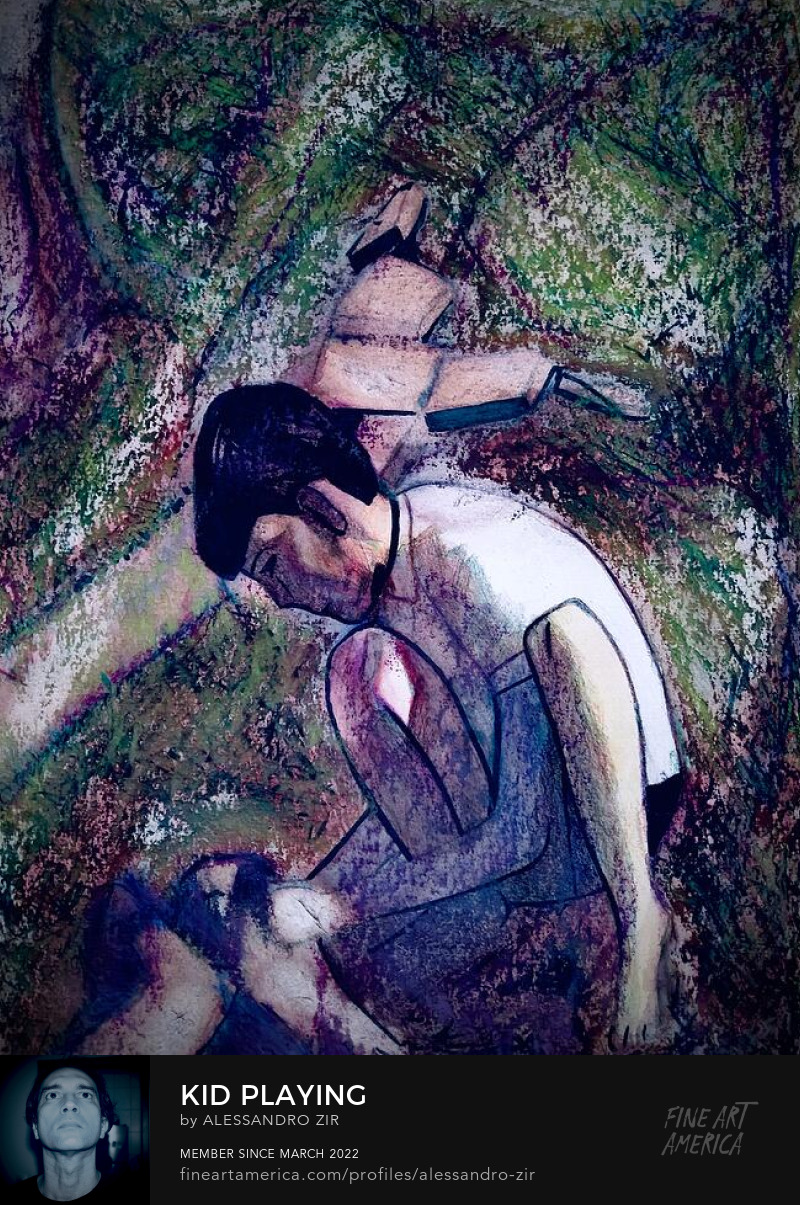
Kid Playing, mixed media drawing by A/Z available with other drawings and photographs at Fine Art America; 
images from Lars von Trier's Europa, 1991; Selim Gunes' Kar Beyaz, 2010; Semi Kaplanoglu's Bal, 2010; Guillermo del Toro's El espinazo del diablo, 2001; David Lynch's The Grandmother, 1970; Hideo Nakata's Honogurai mizu no soko kara, 2002; Ingmar Bergman's Vargtimen, 1968;
The Animation of Lists Part 1 (Warren Burt, Youtube); 
Threads (Paul Lansky, Youtube); 

"Pourtant la pulpe à l'intérieur est veloutée et souple, neutre et apaisante."
Julia Kristeva, Le vieil homme et les loups
"... ma mère adore l'odar de ma merde..."
Marcel Duchamp, Notes
"L'enfant voit tout en nouveauté; il est toujours ivre."
Baudelaire (Le Peintre de la vie moderne)
"There is little Harry calling me."
David
"coucou!"
Pierre Angelici
"...un étalage de figurines translucides qui paraissaient soufflées dans le sucre... des têtes en cire de garçonnets..."
Hervé Guibert

"Who said love will save the kids?"
Tommy Cash
"Blandly mother takes him strolling by railroad and by river..."
Allen Ginsberg
"Nos anos 1950, Santa Izildinha/Luluzinha foi minha superstar. Só que morta."
Rita Lee
"Mon petit frère était mort pendant la guerre du Japon. Il était mort, lui, sans sépulture aucune. Jeté dans une fosse commune par-dessus les derniers corps."
Marguerite Duras (Écrire)
"To have such horrible things happen with small children holding your hand!"
Webern to Hildegard Jone (translated and quoted by Malcolm Hayes)
"... cuatro o cinco hojas relatan la historia de esos adolescentes, casi niños, que el Séptimo Regimiento  recluta sin preguntarles la edad. Porqué lo hace? Porque, según Moreira César, los niños tienen mejor puntería, nervios más firmes que los adultos..."
"Y son niños de pocos años a quienes los caníbales mandan arrastrándose a depositar los hormigueros!"
Mario Vargas Llosa (La guerra del fin del mundo)

"... a noite escura como breu negrejou à minha frente como o infinito desconhecido, perigoso, e o vento arrancou-me o boné da cabeça."
Arkadi Makárovitch Dolgorúki (tradução Paulo Bezerra)
"Au lendemain de cette nuit, le petit Joseph est pris soudain de malaises et de crampes, et meurt en peu d'heures."
Nietzsche (traduction by Klossowski)
"He raised his missile to hurl it... and then ensued, from the stammering lips of the little fellow, a string of curses, which, whether he comprehended them or not, were delivered with practised emphasis, and distorted his baby features into a shocking expression of malignity."
Nelly (Wuthering Heights)
"Face aux états de détresse que nous évoque l'enfant qui se fait entendre mais est incapable de se faire comprendre, nous employons, nous adultes, le mot de 'peur'."
Julia Kristeva, Pouvoirs de l'horreur

"Esse era um dos seus segredos. Nunca se permitiria contar, mesmo a papai, que não conseguia pegar a coisa."
Clarice Lispector
"E a escuridão?"
Andrew Gleiser
"The children all around us are so calming, so elevating!"
Webern to Hildegard Jone (translated and quoted by Malcolm Hayes)
"When one is a child, one has such enormous categories that they would now almost make one dizzy."
Constantine Constantius (translation by M. G. Piety)
"In einer absurd frühen Zeit, mit sieben Jahren, wußte ich bereits, daß mich nie ein menschliches Wort erreichen würde: hat man mich je darüber betrübt gesehn?"
Nietzsche
"Crianças não se dizem adeus."
Iberê Camargo, Gaveta dos Guardados

"... l'art de faire semblant, de mimer, de singer, n'est-il pas indispensable au petit enfant pour qu'il devienne un être autonome, et individu à part que tous nous rêvons d'être?"
"En définitive, toute littérature est peut-être faite pour les enfants."
Joëlle (Les Samuraïs)
"Seulement voilà, les plus adultes restent un peu enfants."
Olga (Les Samuraïs)
"Ce fou savait bien, malgré tout, qu'il était la proie d'une folie et jouait tout de même, dans ces moments-là, puisqu'il savait bien que celui qui le battait n'était pas plus méchant que le petit garçon qui dans les jeux de bataille est désigné au sort pour faire le 'Prussien', et sur lequel tout le monde se rue dans une ardeur de patriotisme vrai et de haine feinte."
Marcel Proust (le narrateur)
"... le genie n'est que l'enfance nettement formulée, douée maintenant, pour s'exprimer, d'organes virils et puissants?"
Baudelaire (Les Paradis artificiels)
"When I was young, people told me: You'll see when you're fifty. I'm fifty. I've seen nothing."
Eric Satie/John Cage
"Originally we were nowhere; and now, again we are having the pleasure of being slowly nowhere. If anybody is sleepy, let him go to sleep."
John Cage (Lecture on Nothing) 
"I like a rut... When I was little and I was sick a lot, those sick times were like little intermissions. Innermissions. Playing with dolls."
Andy Warhol
"Last night I was afraid to lie down. I thought I would die in sleep. I wakened Georgie three times for fear of being alone..."
J. J. (letter to Nora BarnacleJuly 12, 1912) 
"Concentrating qi to its weakest, can you be a baby boy?"
Daodejing/10 (Edumnd Ryden's translation)

"La nomination à laquelle se réfère Françoise Dolto, quand elle dit comment le langage humanise les sons dans lesquels vit l'enfant et qui peuvent l'inquiéter, est un autre problème. Elle consiste non seulement à identifier et à nommer la cause (ce que tu entends, c'est l'aspirateur, c'est la chasse d'eau), mais aussi à permettre de comprendre et de lever l'inquiétude que ces sons peuvent susciter. Nommer les sons en ce sens, les 'mamaïser', comme dit Françoise Dolto, n'est donc bien sûr pas les décrire en eux-mêmes. C'est à cette 'humanisation' des bruits par la parole que fait allusion le poète Rilke, lorsque dans sa Troisième élégie, il s'adresse à une mère, et fait l'éloge de la façon dont elle a rendu pour son enfant le monde 'amical', et la nuit moins inquiétant."
Michel Chion (Le Son) 

"... by the age of about ten or eleven most children have learned what Piaget calls the 'correct' view, namely that thoughts are located inside the head... younger children believe that they travel outside their bodies when they dream... that thoughts are in the mouth, breath and air."
Rupert Sheldrake
"... when I was still a child, I went to the meditation hall to practice in the middle of the night without anyone's knowledge, seeking to attain true faith and wisdom... In observing the practices of the masters of the exoteric and esoteric teachings, I was grieved by their outrageous behavior about which I did not know what should be done..."
Myoe (Mark Unno, Shingon Refractions)
"The worst event of the early months was the incident described in A Portrait and confirmed by Joyce to Herbert Gorman, when another boy broke Stephen's glasses and Father Dolan pandied the victim on the mistaken premise that he had broken the glasses himself to avoid study... Joyce was to speak of Father Dolan later to Gorman as 'low bread'... He did not submit, but went home crying to his mother, who comforted him and mended his clothes." 
Richard Ellmann

List of ingenious movies about children (under construction): 
- Aniki Bobó (Manoel de Oliveira, 1942);
- Germania 90 Graus (Rossellini, 1948);
- Ivanovo detstvo (Andrei Tarkovsky, 1962);
- Mouchette (Robert Bresson, 1967);
- Vargtimmen (Igmar Bergman, 1968); 
- The Grandmother (David Lynch, 1970);
- Le Souffle au Coeur (Louis Malle, 1971);
- Ivanovo detstvo (Tarkovsky, 1972);
- Sjecas li se Dolly Bell? (Emir Kusturica, 1981);
- Khane-ye doust kodjast (Abbas Kiarostami, 1987); 
- Je suis le Seigneur du Château (Régis Wargnier, 1989);
- Europa (Lars von Trier, 1991);
- L'année de l'éveil (Gerard Corbiau, 1991);
- Léolo (Jean-Claude Lauzon, 1992);
- Badkonaki sefid (Jafar Panahi, 1995); 
- Butcher Boy (Neil Jordan, 1997);
- La Ciénaga (Lucrecia Martel, 2001);
- Honogurai mizu no soko kara (Hideo Nakata, 2002);
- Tout Contre Leo (Honoré, 2002);
- Palindromes (Todd Solondz, 2004);
- The Boy in the Striped Pyjamas (Mark Herman, 2008);
- Das weisse Bande (Michael Haneke, 2009);
- Kar Beyaz (Selim Gunes, Turkey, 2010);   
- Bal (Semih Kaplanoglu, 2010);
- Submarino (Thomas Vinterberg, 2010); 
- Pelo Malo (Mariana Rondón, 2013);
- Mommy (Xavier Dollan, 2014); 
- Território do Brincar (Renata Meirelles, David Reeks, 2015);
- Fai bei Sogni (Marco Bellocchio, 2016);