Showing posts with label Machado de Assis. Show all posts

Thursday, December 15, 2016

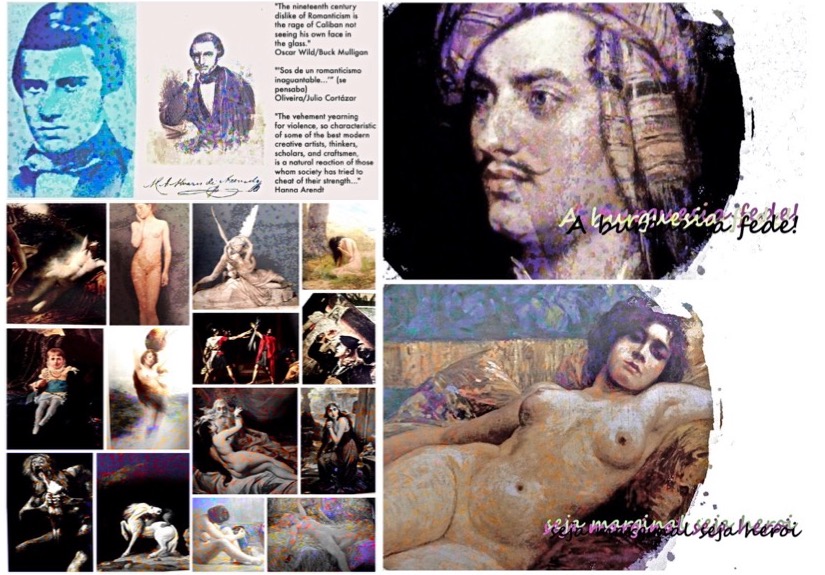
Icons of Romanticism (Brazil)


"'Sos de un romanticismo inaguantable'"
(se pensaba) Oliveira & Julio Cortázar
"Joyce took pleasure in undercutting romanticism, so when Budgen happened to speak of the 'heart,' Joyce commented, 'The seat of the affections is lower down, I think."
Richard Ellmann

"The nineteenth century dislike of Romanticism is the rage of Caliban not seeing his own face in the glass." 
Oscar Wild & Buck Mulligan
"Hat Jemand, Ende des neunzehnten Jahrhunderts, einen deutlichen Begriff davon, was Dichter starker Zeitalter Inspirationnannten? Im andren Falle will ich’s beschreiben..."
Nietzsche (Ecce Homo)
"The vehement yearning for violence, so characteristic of some of the best modern creative artists, thinkers, scholars, and craftsmen, is a natural reaction of those whom society has tried to cheat of their strength..."
Hanna Arendt

Em Álvares de Azevedo "havia uma certa razão de consanguinidade com Byron e uma íntima convivência com os poetas do norte da Europa". 
"... uma verdadeira sensibilidade. A melancolia de Azevedo era sincera."
"Como poeta humorístico, Azevedo ocupa um lugar muito distinto. A viveza, a originalidade, o chiste, o humor dos versos deste gênero são notáveis."
- Machado de Assis, "Lira dos Vintes Anos".

"Quem souber apreciar a cristalina, abstrata e rigorosa arquitetura dodecafônica, quase geométrica, de sua 'Suíte para piano'opus 25 ou de seu 'Quinteto de sopros', jamais poderá imaginar que a frase que se segue foi dita por Arnold Schönberg: 'Aquele que não possuir o romantismo em seu coração é um ser humano decrépito."
"Schönberg soube entender e mesmo exercitar muito bem o pathos wagneriano, mas, em vez de tentar espichá-lo ou 'modernizá-lo', como o fez Richard Strauss, ele provocou a sua imposão. Ao contrário de Debussy, que assumiu um radical distanciamento daquele estilo e técnicas composicionais, tecendo por fora e lentamente a sua contribuição renovadora, Schönberg provocou um envenenamento na engrenagem das formas, levando-as ao superlativo da expressividade, ao conflito, a uma neurótica impulsiva subjetividade onde o indivíduo situava-se como centro absoluto, intérprete e juiz do universo. A evolução desse comportamento espiritual, que veio desembocar em nosso século no expressionismo; que contou com figuras como Nolde, Kokoschka, Kandinsky, Chagal e Roualt na pintura; Wedekind, Werfel e Kafka na literatura; Wiene, Lang, Pabst, Dreyer e Murnau, no cinema, teve, em música, na obra de Arnold Schönberg, o seu carro-chefe."
Júlio Medaglia (Música Impopular)

"... como um poema que cismei numa semana de febre — uma aberração dos princípios da ciência."
"Conhaque! Não te ama quem não te entende!"
"E eis-te aí vazia, minha garrafa! Vazia como mulher bela que morreu!"
"Fumais? Perguntais de que serve o tinteiro sem tinta..."
Algumas mulheres "em falta de cabelos na cabeça os têm no coração".
"A meretriz é um cadáver. Vale-nos ao menos que sobre seu peito não se morre de frio!"
"A maior desgraça deste mundo é ser Fausto sem Mefistófeles..."
"... o que é tudo no mundo senão vapor?"
"Dizem que se a rabeca de Paganini dava sons tão humanos, tão melodiosos, é que ele fizera passar a alma de sua mãe pelas cordas de seu instrumento."
"Não há melhor túmulo para a dor que uma taça cheia de vinho ou uns olhos negros cheios de languidez."
"Não maldigas a voz rouca do corvo: ele canta na impureza um poema desconhecido."
"... nos mangues e nas águas do Amazonas e do Orenoco há mais mosquitos e sezões do que inspiração."
"... o ateísmo como na Rainha Mab de Shelley."
"A filosofia é uma cripta escura onde se esbarra na treva."
"Fausto é Werther que envelheceu."
- Alvares de Azevedo, Macário.
"Aqui dissipa-se o mundo visionário e platônico."
"A poesia é um defeito no cérebro."
"Se Adão pecou em estado de inocência, que muito é que nos dias da impureza peque o mísero Puff?"
"Este demônio de um poeta como eu nem vale um murro!"
"Ora, façam ideia que ternuras terá essa lagarta posta a fresco!"
"... como cala o vento do trópico na podre calmaria."
- Alvares de Azevedo, segunda e terceira parte da Lira dos Vinte Anos.
"A noite escura é negra como um túmulo. Durmamos."
- Alvares de Azevedo, "Gloria Moribunda".

Alvares de Azevedo “foi o primeiro, quase o único antes do Modernismo, a dar categoria poética ao prosaísmo cotidiano, à roupa suja, ao cachimbo sarrento; não só por exigência da personalidade contraditória, mas como execução de um programa conscientemente traçado”.
- Antônio Cândido, “Alvarez de Azevedo, ou Ariel e Caliban”, Formação.

See also:
- Pour une littérature mineur: Mário Quintana as I see him;
- Pau Brasil (Oswald de Andrade);
- Mario de Andrade, tel que je l'imagine (bricolage & fragments);
- Noite Morta (Manuel Bandeira, 1921);
- Favorite Drummond (with translation);
- Podem ficar com a realidade (Leminski);
- Poème du retour: Paulo Leminski et l'éternel moustache de Nietzsche;
- Two invisible phanopoeias & a silence (by Arnaldo Antunes) + Alice Ruiz;
- "Pronomes Pessoais dos Casos Reto e Oblíquo: A Função Sintática no Português Atual e Arcaico" (Raymundo José da Silva/UEMS/filologia.org.br); 

Excerpts from a Michèle Lamy & GAIKA interview (Dazed, March 2018): 
"I always want to explore ‘radical luxury’ – I mean, I like radical more than I like luxury, and it’s very nice to be able to combine art and the commercial, but it’s one thing to say something, but you need to demonstrate it with the theme. And so we have the collection upstairs and this here (the boxing studio)." 
"For me it’s about equality, it’s about honesty. It’s about all these things where I can’t accept the alternative. Like some of the things we just seem to accept in the world as normal. Misogyny, racism, intolerance, you know, we have conversations surrounding these things in the media all the time, but nothing’s changing. And when you think about it, it’s pretty abhorrent. You know, you have to tell men not to rape people, like, including people who supposedly run the world, they have to be told not to rape…"
"I think boxing is a good metaphor for the fight we face and how we should be fighting it. You know, boxing is one-on-one. You look your opponent in the eyes and there are a lot of rules and and there is a lot of respect, traditionally. You know, it brings in a lot of different people; you take people off the street, and kids, and people from all different walks of life, and you see people realise themselves and their potential in the boxing ring. Instead of taking a gun and shooting 20 people in anger, you can be measured and see how to be strong and how to stand for yourself as an individual here."
"The world’s changing and I think the power in the world is shifting and changing. It’s shifting away from the West, it’s shifting away from men, and you’ve got one of two reactions: accept the world is changing and be part of it, or build walls, physically or metaphorically to stop it and to block it out... Yeah, to be like Trump and his wall, you know, in the White House cowering thinking ‘we are the last supreme white beings’, sitting there with his finger on the nuclear button... So extreme. You know, I think that it (Trump’s appointment) made a lot of people wake up..."
"You know, it never really made sense to me – the massive amount of inequality in the world just seems unnecessary. It just doesn’t seem like an efficient way to keep the world turning if you think of it as a machine or a structure. It’s purely about ego as far as I can tell, it’s not even just about the material side of things or money, it’s about dominance."
"... since the dawn of the internet, and people being constantly connected to these violent images every minute, every second, it’s important that the press change too. The media should be analysing themselves and changing the way they do things. I want to see unbiased opinions, I don’t want to see left-wing newspapers or right-wing newspapers. I want to see a tribune that covers it all in a fair way..." Michèle Lamy and GAIKA go head to head on the fight for the future (Dazed, 2018);

Wednesday, August 05, 2015

Augusto Meyer and Machado de Assis (Cristovão Tezza and others)


l'evangile après Salo (A/Z 2017) [I took this video out of Youtube, because I wanted to change it];
Schoenberg's Pierrot Lunaire (directed by Oliver Herrmann, singed by Christine Schäfer & conducted by Pierre Boulez); 
Massimo Cacciari racconta Leopardi (Youtube 2019);
A Suavidade do Vento/Cristovão Tezza (AZ Youtube); 
O Caso Morel/Rubem Fonseca (AZ Youtube); 

"... as Virgil disappeared as Dante's guide on Mt. Purgatory... so Braz's life is not only a failure in the picaresque cadre, it is incomplete in another sense." 
Helen Caldwell, Machado de Assis
"Vocês são muito radicais. O arco não pode ficar tenso todo o tempo. Vocês vão ter de afrouxar."
"No meio da geléia geral brasileira alguém tem de fazer o papel de osso e de medula."
(diálogo entre Cassiano Ricardo & Décio Pignatari/Augusto de Campos, Reflashes para Décio)

"Thought is happiness, even where it defines unhappiness: by enunciating it. By this alone happiness reaches into the universal unhappiness."
Theodor W. Adorno, Essays on Music
"Die Phantasmagoric, in der der Wartende seine Zeit zubringt, das aus Passagen erstellte Venedig, das das Empire den Parisern als Traum vorgaukelt, verflosst auf seinem Mosaikband nur einzelne. Daher kommen bei Baudelaire keine Passagen vor."
Walter Benjamin

"For Adorno, the false consciousness of Stravinsky's music is its truth, in that it tells us how the world is, while at the same time urbanely convincing us that this is the only way it can be. It is, of course, only when he lies that the devil tells the truth — something that could be seen to apply as well to Adorno as to Stravinsky. For as Adorno said of psychoanalysis, 'nothing is true except the exaggerations.'"
Max Paddison (Stravinsky as devil: Adorno's three critiques)
"Outra vez Nietzsche é quem diz magistralmente que o artista nunca é 'pessimista', pois mesmo na crise ele só diz sim, e a vida e a atividade dele e o terrível são abordados numa variação de sims (ou sins), longe de perdas e anéantissement..."
Hélio Oitica (Carta à Lygia Clark)

"Being smart could make you depressed, certainly, if you weren't smart about what you were smart about."
Andy Warhol, The Philosophy of Andy Warhol
"La spirale dont il est question n'est-ce pas justement celle qui crée la confusion totale, voire le complet renversement entre le haut et le bas?"
Henri Pousseur, Musiques Croisées
"... il se tient dans le dehors. Et contre cette menace il ne doit pas se défendre, il doit au contraire s'y livrer."
Maurice Blanchot ('Où maintenant? Qui maintenant?')
"... l'auteur... doit chercher par et dans son oeuvre ce qui, niant ses propres limites, ses faiblesses, ne participe pas de sa servitude profonde." 
Georges Bataille, La littérature et le mal 
"... there is a difference between Bitterness and Saltness—that is,—between the malignity and the festivity of wit,—the one is a mere quickness of apprehension, void of humanity,—and is a talent of the devil; the other comes down from the Father of Spirits, so pure and abstracted from persons, that willingly it hurts no man..."
Laurence Sterne ('The Levite and his concubine")
"In mentioning the word gay, it puts one in mind of the word spleen... not that by any analysis there appears much more ground of alliance betwixt them, than betwixt light and darkness..."
Tristram Shandy

"... meine Humanität besteht nicht darin, mitzufühlen, wie der Mensch ist, sondern es auszuhalten, daß ich ihn mitfühle..."
Nietzsche (Ecce Homo)
"Não compreendi sequer que ela se mascarava, de propósito, com aquela zombaria, que era o último ardil das pessoas envergonhadas e de coração virtuoso, quando alguém lhes procura penetrar a alma, de modo rude e insistente..."
Memórias do Subsolo (tradução Boris Schnaiderman)

"Comme c'est par tromperie que Soslan l'a surpris et tue, un jour viendrá où, chez le morts, le duel recommencera entre Totyradz et le héros d'acier. Et ce ne sera pas un duel ordinaire. Les morts se presseront à ce spectacle. Pour mieux voir, ils monteront sur les cibles..." 
Le livre des heros (traduction Dumézil)
"That Nature is always right, is an assertion, artistically, as untrue, as it is one whose truth is universally taken for granted. Nature is very rarely right, to such an extent even, that it might almost be said that Nature is usually wrong: that is to say, the condition of things that shall bring about the perfection of harmony worthy a picture is rare, and not common at all."
Whistler

"Ne suis-je pas un faux accord
Dans la divine symphonie,
Grâce à la vorace Ironie
Qui me secoue et qui me mord?"
"... si, sans se laisser charmer,
Ton oeil sait plonger dans les gouffres..."
Baudelaire
"Epikur ein typischer décadent: zuerst von mir als solcher erkannt."
Nietzsche (Der Antichrist)

"Hochverehrter Herr ich habe mich durch Ihren Brief viel zu erfreut und geehrt gefühlt, um mir nicht den Vorschlag, welchen Sie mir in Betreff Leopardi’s machen, zehnfach zu überlegen. Ich kenne dessen prosaische Schriften freilich nur zum kleinsten Theile; einer meiner Freunde, der mit mir in Basel zusammenwohnt, hat öfters einzelne Stücke daraus übersetzt und las sie mir vor, jedes mal zu meiner grossen Überraschung und Bewunderung; wir besitzen die neueste Livorneser Ausgabe."
Nietzsche (Brief an Hans von Bülow, 02/01/1875)
"Indem die Kunst Wagner’s uns auf Augenblicke aus ihr hinausträgt, vermögen wir ihren gleichartigen Charakter überhaupt erst zu überschauen: da erscheinen uns Goethe und Leopardi als die letzten grossen Nachzügler der italienischen Philologen-Poeten, der Faust als die Darstellung des unvolksthümlichsten Räthsels, welches sich die neueren Zeiten, in der Gestalt des nach Leben dürstenden theoretischen Menschen, aufgegeben haben; selbst das Goethische Lied ist dem Volksliede nachgesungen, nicht vorgesungen, und sein Dichter wusste, weshalb er mit so vielem Ernste einem Anhänger den Gedanken an’s Herz legte: 'meine Sachen können nicht populär werden; wer daran denkt und dafür strebt, ist im Irrthum.' Dass es überhaupt eine Kunst geben könne, so sonnenhaft hell und warm, um ebenso die Niedrigen und Armen im Geiste mit ihrem Strahle zu erleuchten, als den Hochmuth der Wissenden zu schmelzen: Das musste erfahren werden und war nicht zu errathen."
Nietzsche (Richard Wagner in Bayreuth)

"Indem nämlich die Vielheit unverbundener Einzeltriebe sich in zwei einander gleichsam gegenüber stehende Wesenheiten zerspaltet, von denen die Eine herrscht, die Andere dient, — wird es dem Menschen ermöglicht, zu sich selber nicht nur wie zu einem anderen, sondern auch wie zu einem höhern Wesen zu empfinden. Indem er einen Theil seiner selbst sich selber zum Opfer bringt, ist er einer religiösen Exaltation nahe gekommen. In den Erschütterungen seines Geistes, in denen er das heroische Ideal eigener Preisgebung und Hingebung zu verwirklichen wähnt, bringt er an sich selbst einen religiösen Affect zum Ausbruch." 
"Von allen grossen Geistesanlagen Nietzsches gibt es keine, die tiefer und unerbittlicher mit seinem geistigen Gesammtorganismus verbunden gewesen wäre, als sein religiöses Genie. Zu einer anderen Zeit, in einer andern Culturperiode würde dasselbe diesem Predigerssohn sicherlich nicht gestattet haben, zum Denker zu werden. Unter den Einflüssen unserer Zeit erhielt jedoch sein religiöser Geist die Richtung aufs Erkennen und vermochte dasjenige, wonach es ihn instinctiv am drängendsten verlangte, wie nach dem natürlichen Ausdruck seiner Gesundheit, nur in krankhafter Weise zu befriedigen, — das heisst, er vermochte es nur vermittelst einer Rückbeziehung auf sich selbst anstatt auf eine ihn mit umfassende, ausser ihm liegende Lebensmacht."
"So erreichte er das gerade Gegentheil des Angestrebten: nicht eine höhere Einheit seines Wesens, sondern dessen innerste Zweitheilung, nicht den Zusammenschluss aller Regungen und Triebe zu einem einheitlichen Individuum, sondern ihre Spaltung zum »Dividuum«. Es war immerhin eine Gesundheit erreicht, — doch mit den Mitteln der Krankheit; eine wirkliche Anbetung, doch mit den Mitteln der Täuschung; eine wirkliche Selbstbehauptung und Selbsterhebung, doch mit den Mitteln der Selbstverwundung."
Lous Salomé
**************************************************************

Augusto Meyer's literary criticism about Machado de Assis is nowadays recognized as pivotal. Professor Regina Zilberman (Federal University of Rio Grande do Sul) writes the following in the back flap of a recent edition of Meyer's essays: "Augusto Meyer holds a creditable position... in the legacy of studies about the most important Brazilian writer before the advent of Modernism" (see Augusto Meyer, Machado de Assis. 1935-1958. Rio de Janeiro: José Olympio, 2008).
Antonio Candido is perhaps more strict: "sometimes... an accessible surface devoid of any mystery conceals to a less experienced reader or literary period values that are rare and profound. A typical example is Machado de Assis—celebrated for a long time in view of what in him was most flippant [epidérmico], till Augusto Meyer, Lúcia Miguel-Pereira and Barreto Filho (his most outstanding critics) highlighted recently the innermost power that constitutes his real and singular greatness" (A Formação da Literatura Brasileira. Rio de Janeiro: Ouro sobre Azul, 2012, p. 453).  
What should we make of this?
The relevance of Augusto Meyer's criticism about Machado de Assis is neat: it opposes the inane image of Machado de Assis as a "benevolent" skeptic, common among Machado's contemporaries such as Alcindo Guanabara (a Brazilian journalist and politician of the time) (see Meyer, Machado de Assis, p. 130). But it should be circumscribed to this point.
The image of Machado de Assis created by Meyer himself is equally preposterous. Meyer conflates what he thinks are Machado de Assis's ideas with the ideas expressed by Machado's narrators and characters. Meyer's procedure betrays a misunderstanding of something which is essential to literary writing: its fictional, counterfactual character.
It is exactly because Machado de Assis pushes literary writing to its limits, arriving at enigmatical, sometimes profoundly somber outlines and intuitions, that he is not Meyer's "subterranean man."
Machado de Assis's brilliant criticism of Eça de Queirós's O Primo Basílio (referred just en passant by Meyer, Machado de Assis, p. 106), shows that Machado had a very perspicuous understanding of both the nature of literary writing and the "limits" of literary movements such as the so-called naturalism of some 19th-century authors. The problem with naturalism was not that it dwelled on the abject, but that it adhered too much to "reality"—an alleged abject reality that naturalism would display in an "implacable, cogent, and logical" way (see Machado de Assis, "O Primo Basílio de Eça de Queirós").*
Meyer is completely mistaken when he attributes to Machado "a conscience that recognizes the uselessness of conscience" (Machado de Assis, p. 101). The case is exactly the opposite: through literary writing, Machado fully exercises his conscience—exceeding but by the same token remaining faithful to it. What Georges Bataille correctly says against merely "existentialist" perspectives (à la Sartre) in literature, wouldn't apply to Machado: "un désir de néant qui ne voulut pas recevoir de limite est réduit à la vaine agitation" (La littérature et le mal. Paris: Gallimard, 1957, p. 138).
Machado never succumbs to vain agitation. The "stasis" [inércia] that Meyer attributes to Machado's late works (Machado de Assis, p. 100, cf. 41) is the highest outcome of literary writing. In relation to Quincas Borba, for instance, John Gledson remarked more recently something obvious that has nonetheless been systematically bypassed by many other readers: the plot fairly and squarely contradicts the novel’s motto (see Gledson’s introduction to this novel). The motto (ao vencedor as batatas) is deflated rather than praised, and through a process to which the main character (Rubião) is submitted (he is not the agent of the plot).** One should call this DECONSTRUCTION. It is also involved in what Meyer calls “neutralization”—a neutralization that would come from an “excess of clairvoyance” (Machado de Assis, p. 32).
It is possible to say, with Roberto Schwarz, that Machado was led to such an extreme process by certain bias, dislocations, and dissociations typical of the Brazilian society of the period (a society based on slavery and also on a system of dispensation of favors and counter-favors, upon which the writers depended, although the official ideals and values came from liberal Europe) (see Schwarz, Ao Vencedor as Batatas. São Paulo: Editora 34, 2000, p. 16-21, 195-96, 199, 210).*** But it is the process in itself (a certain kind of literary writing) that explains Machado’s labyrinth: a “literary” rather than a psychological or social labyrinth. One should remember that it is through writing that one can both create and deconstruct psychological and social categories, prejudices, and expectations. Moreover, it is through a certain kind of writing that one can problematize what lies perhaps beneath these categories, prejudices, and expectations (being irreducible to them).****
Besides "stasis" and "neutralization," other provocative notions used by Meyer are "virtuality" (Machado de Assis, p. 85) and "vicious circle" (p. 59). The same words have been applied in a somewhat different way to Nietzsche by one of his most insightful exegetes: Pierre Klossowski. 
************************************************************

*Deleuze says the following about la Bête humaine, which he characterizes as Zola’s epic: "le essential de l’épopée, c’est un double registre où les dieux, activement, jouent à leur manière et sur un autre plan l’aventure des hommes et de leurs instincts" (Logique du sens, p. 384); a few paragraphs later, "la fêlure ne traversait et n’aliénait la pensée que pour être aussi la possibilité de la pensée, ce à partir de quoi la pensée se développe et se recouvre" (p. 386). Oswald de Andrade: "Trasponho a vida. Não copio igualzinho. Nisso residiu o mestre equívoco naturalista… Tudo em arte é descoberta e transposição" ("Objeto e fim da presente obra," Serafim Ponte Grande).
**The unreability of Machado’s narrator had already been unequivocally ascertained by other English [?] critic, referred by Gledson, and who influenced his analysis: J. C. Kinnear. In his article “Machado de Assis: To Believe or Not to Believe,” Kinnear says that “Brás Cubas, Dom Casmurro and the narrator of Quincas Borba are to a large extent unrealiable because they write books which lay claim to total truth, which have no awareness of their limitations… Quincas Borba is all the more remarkable because it is a third-person novel with an unreliable narrator: there is one Machado, claiming to give pure representational realism, often with the pessimistic overtones of the naturalist novel, and another Machado undermining that pretence” (The Modern Language Review, vol 71, n. 1, Jan. 1976, p. 54-65). Later on, in the same article, Kinnear will refer to Helen Caldwell, the North-American critic who, in 1960, first brought attention to the fact that Dom Casmurro’s narrator is completely unrealiable.
***In the biographical outline of Machado de Assis given by Lucia Miguel-Pereira in her "Pesquisas Psicológicas," one finds condensed many concrete elements that give support to Schwarz’s thesis: “Orphan by mother while still a little boy, and by father a little later, Joaquim Maria Machado de Assis found in his stepmother, Maria Inês, kindness and shelter. In 1856 he is admitted to the Imprensa Nacional as apprentice typographer. Two years later, he becomes proofreader for the publishing house of Paula Brito, a close friend. With the help of Pedro Luís, he is offered the same job at the Correio Mercantil. He publishes poems, essays and his first fictions in Marmota, a magazine of Paula Brito. In 1860, with the help of Quintino Bocaiúva, he starts to work in the newsroom of the Diário do Rio de Janeiro. He also collaborates with the Semana Ilustrada… At the age of 30, he marries D. Carolina Augusta de Novais, the sister of Faustino Xavier de Novais, his partner at the magazine O Futuro” (Lucia Miguel-Pereira, Prosa de Ficção. Rio de Janeiro: José Olympio, 1957, p. 60). The information concerning the death of Machado’s parents is not accurate (see Caldwell, Machado de Assis: The Brazilian Master and His Novels. Berkeley: Univ. of California Press, 1970, p. 14-15), but the whole picture is truthful. One wonders why Lucia Miguel-Pereira’s criticism remains out of print, while Meyer’s is being reedited. She is a better critic.
****Schwarz’s Ao Vencedor as Batatas was originally published in 1977. Paradoxically enough, it is much more enlightened than Schwarz’s second book about Machado de Assis, Um mestre na periferia do capitalismo, originally published in 1990. One wonders why John Gledson translated the second book into English instead of the first. Perhaps because he is there quoted, perhaps because the book can be taken as a good example of the sociological and historicist bias that in the end undermines almost all Brazilian literary criticism, with the exception of the criticism written by Haroldo de Campos. One should remember that Haroldo de Campos was himself a (concretist) poet and an outstanding translator—that is, a writer. His O Sequestro do Barroco na Formação da Literatura Brasileira is a brilliant attack on both the sociologism and the psychologism that pervade Brazilian literary studies. One of the most felicitous books ever written about Machado de Assis—O Calundu e a Panacéia (by Enylton de Sá Rego), unfortunately out of print!—was conceived after its author attended to a colloquium given by Campos in the University of Texas at Austin. Returning to Schwarz’s second book, the problem lies with its main thesis. It is impossible to reduce—as Schwarz tries to do, the paradoxical characteristics of the narrator of Memórias Póstumas de Bras Cubas to “class ideology.” They go beyond that, and what Schwarz calls “metaphysical skid” [derrapagem metafísica] is essential to Machado’s work. Ultimately, "whim" and "spirit of negation," if correctly understood, are not things amenable to "dialectical" treatment. This is the immemorial sans fond in which more or less invisibly just now hangs the abyss between "dust and darkness" [pó e trevas] and "the gentleness of the wind" [A Suavidade do Vento, 1991/2015] in Cristovão Tezza’s skilled prose. In an essay in which he discusses the fate of avantgard poetry (and cinema) in (neo)capitalist societies, Pier Paolo Pasolini once referred to the responsibility of “raising questions” through “amphibological works” [porre delle domande in opere anfibologiche], whose understanding would demand “an extension and a necessary methodological modification of Marxist analysis” [un allargamento e forse... una modifica metodologica dell'analisi marxista], and which are actually not under Marxist jurisdiction (Empirismo eretico, 147). In O espírito da prosa, Tezza attacks in a more or less superficial way what he calls "a nihilist new wave of radical criticism" (decrying with a somewhat lowbrow philistinism traditions of literary theory going back to the Russian formalists, with the exception of Bakhtin). But when trying to convey what turns people into writers (in the 19th and 20th centuries), Tezza is unable to bypass a "monstrous" experience of subjective exhaustion: "experimentem trancar o filho num quarto escuro, amarrando sua perna numa estaca irremovível; cortem sua comida pela metade ou, ao contrário, abarrotem-no de calorias, para em seguida reclamar que estão gordos..." (p. 49-50).

***To raise the dead— &/or evidence for the villainous affair, the tale of family disonour, Romish church's pact with the devil (considered the greatest outrage against sense and decency, to be plagued and pestered, though solemnly ratified, à Dieu rien n'est impossible, menteur avéré, nom d'un chien):
"Although Greek names were sometimes applied to the church modes and the principle of diatonic octave scales is found in both systems, certain significant discrepancies seem to belie any direct historical connection. Most conspicuous is the different meaning attributed to the names of the Greek octave species and of the church modes. Comparing the two systems provides a plausible explanation: medieval theorists apparently assumed wrongly that the Greek octave species were named in ascending rather than descending order. The Greek octave species Dorian (E–E), Phrygian (D–D), Lydian (C–C), and Mixolydian (B–B) thus appeared in the church modes as Dorian (D–D), Phrygian (E–E), Lydian (F–F), and Mixolydian (G–G)," (from "Mode," entry in Brittanica, by Mieczyslaw Kolinski);

See also:
And also:

Saturday, May 09, 2015

O Primo Basílio de Eça de Queirós

"Je m'en assurais par la fausseté même de l'art prétendu réaliste et qui ne serait pas si mensonger si nous n'avions pris dans la vie l'habitude de donner à ce que nous sentons une expression qui en diffère tellement, et que nous prenons au bout de peu de temps pour la réalité même.  Je sentais que je n'aurais pas à m'embarrasser des diverses théories littéraires qui m'avaient un moment troublé—notamment celles que la critique avait développées au moment de l'affaire Dreyfus et avait reprises pendant la guerre et qui tendaient à faire sortir l'artiste de sa tour d'ivoire."
Marcel Proust (le narrateur)

"Et Nietzsche qui dénonce ailleurs la mystique du néant, parle ici des misérables réduits où vont se perdre avec violence les plus intelligents de nos contemporains, dans des professions de foi de chapelles esthétiques, tel le naturalisme parisien... ou dans le nihilisme selon le modèle de Saint-Pétersbourg, c'est-à-dire dans la croyance à la vertu de l'incroyance jusqu'au martyre pour cette dernière..."
Pierre Klossowski (Un si funeste désir) 
************************************************************

"Um dos bons e vivazes talentos da atual geração portuguesa, o sr. Eça de Queirós, acaba de publicar o seu segundo romance, O Primo Basílio. O primeiro, O Crime do Padre Amaro, não foi decerto a sua estréia literária. De ambos os lados do Atlântico, apreciávamos há muito o estilo vigoroso e brilhante do colaborador do sr. Ramalho Ortigão, naquelas agudas Farpas, em que aliás os dois notáveis escritores formaram um só. Foi [com] a estréia no romance, e tão ruidosa estréia, que a crítica e o público, de mãos dadas, puseram desde logo o nome do autor na primeira galeria dos contemporâneos. Estava obrigado a prosseguir na carreira encetada; digamos melhor, a colher a palma do triunfo. Que é, e completo, e incontestável.
Mas esse triunfo é somente devido ao trabalho real do autor? O Crime do Padre Amaro revelou desde logo as tendências literárias do sr. Eça de Queirós e a escola a que abertamente [154] se filiava. O sr. Eça de Queirós é um fiel e aspérrimo discípulo do realismo propagado pelo autor do Assommoir. Se fora simples copista, o dever da crítica era deixá-lo, sem defesa, nas mãos do entusiasmo cego, que acabaria por matá-lo; mas é homem de talento, transpôs ainda há pouco as portas da oficina literária; e eu, que lhe não nego a minha admiração, tomo a peito dizer-lhe francamente o que penso, já da obra em si, já das doutrinas e práticas, cujo iniciador é, na pátria, de Alexandre Herculano e no idioma de Gonçalves Dias.
Que o sr. Eça de Queirós é discípulo do autor do Assommoir, ninguém há que o não conheça. O próprio Crime do Padre Amaro é imitação do romance de Zola, La faute de l'abbée Mouret. Situação análoga, iguais tendências; diferença do meio; diferença do desenlace, idêntico estilo; algumas reminiscências, como no capítulo da missa, e outras; enfim, o mesmo título. Quem os leu a ambos não contestou decerto a originalidade do sr. Eça de Queirós, porque ele a tinha, e tem, e a manifesta de modo afirmativo; creio até que essa mesma originalidade deu motivo ao maior defeito na concepção do Crime do Padre Amaro [...] [155]. [O] padre Amaro vive numa cidade de província, no meio de mulheres, ao lado de outros que do sacerdócio só têm a batina e as propinas; vê-os concupiscentes e maritalmente estabelecidos, sem perderem um só átomo de influência e consideração. Sendo assim, não se compreende o terror do padre Amaro, no dia em que do seu erro lhe nasce um filho, e muito menos se compreende que o mate. Das duas forças que lutam na alma do padre Amaro, uma é real e efetiva — o sentimento da paternidade; a outra é quimérica e impossível — o terror da opinião, que ele tem visto tolerante e cúmplice no desvio dos seus confrades; e não obstante, é esta a força que triunfa.
Ora bem, compreende-se a ruidosa aceitação do Crime do Padre Amaro. Era realismo implacável, consequente, lógico, levado à puerilidade e à obscuridade [...]. Não se conhecia no nosso idioma aquela reprodução fotográfica e servil das coisas mínimas e ignóbeis. Pela primeira vez, aparecia um livro em que o escuso e o [...] [156] torpe eram tratados com um carinho minucioso e relacionados com uma exação de inventário. [...] Pois que havia de fazer a maioria, senão admirar a fidelidade de um um autor que não esquece nada, e não oculta nada? Porque a nova poética é isto, e só chegará à perfeição no dia em que nos disser o número exato dos fios de que se compõe um lenço de cambraia ou um esfregão de cozinha [...]. 
Certo da vitória, o sr. Eça de Queirós reincidiu no gênero, e trouxe-nos O Primo Basílio, cujo êxito é evidentemente maior que o do primeiro romance, sem que, aliás, a ação seja mais intensa, mais interessante ou vivaz, nem mais perfeito o estilo. A que atribuir a maior aceitação deste livro? Ao próprio fato da reincidência, e, outrossim, ao requinte de certos [157] lances que não destoaram do paladar público. Talvez o autor se enganou em um ponto. Uma das passagens que maior impressão fizeram no Crime do Padre Amaro, foi a palavra de calculado cinismo, dita pelo herói. O herói de O Primo Basílio remata o livro com um dito análogo; e, se no primeiro romance é ele característico e novo, no segundo é já rebuscado, tem um ar de cliché; enfastia. Excluído esse lugar, a reprodução dos lances e do estilo é feita com o artifício necessário, para lhes dar novo aspecto e igual impressão. 
Vejamos o que é O Primo Basílio e comecemos por uma palavra que há nele. Um dos personagens, Sebastião, conta a outro o caso de Basílio, que, tendo namorado Luísa em solteira, estivera para casar com ela; mas falindo o pai, veio para o Brasil, donde escreveu desfazendo o casamento. — Mas é a Eugênia Grandet! exclama o outro. O sr. Eça de Queirós incumbiu-se de nos dar o fio da sua concepção. [...] [D]evo dizer, desde já, que de nenhum modo plagiou os personagens de Balzac. A Eugênia deste, a provinciana singela e boa, [158] cujo corpo, aliás robusto, encerra uma alma apaixonada e sublime, nada tem com a Luísa do sr. Eça de Querós. Na Eugênia há uma personalidade acentuada, uma figura moral, que por iso mesmo nos interessa e prende; a Luísa — força é dizê-lo — a Luísa é um caráter negativo, e no meio da ação ideada pelo autor, é antes um títere do que uma pessoa moral.
Repito, é um títere; não quero dizer que não tenha nervos e músculos; não tem mesmo outra coisa; não lhe peçam paixões nem remorsos; menos ainda consciência.
Casada com Jorge, faz este uma viagem ao Alentejo, ficando ela sozinha em Lisboa; aparece-lhe o primo Basílio [...]. Ela já não o ama; quando leu a notícia da chegada dele, doze dias antes, ficou muito 'admirada'; depois foi cuidar dos coletes do marido. Agora, que o vê, começa por ficar nervosa [...]; diz-lhe que estimara ter vindo justamente na ocasião de estar o marido ausente [...]. A tarde e [159] a noite gasta-as a pensar ora no primo, ora no marido. Tal é o intróito de uma queda, que nenhuma razão moral explica, nenhuma paixão, sublime ou subalterna, nenhum amor, nenhum despeito, nenhuma perversão sequer. Luísa resvala no lodo, sem vontade, sem repulsa, sem consciência; Basílio não faz mais do que empuxá-la, como matéria inerte, que é. Uma vez rolada ao erro, como nenhuma flama espiritual a alenta, não acha ali a saciedade das grandes paixões criminosas: rebolca-se simplesmente [...]. 
[A]qui chegamos ao defeito capital da concepção do sr. Eça de Queirós. A situação tende a acabar, porque o marido está prestes a voltar do Alentejo, e Basílio começa a enfastiar-se, e, já por isso, já porque o instiga um companheiro seu, não tardará a trasladar-se a Paris. Interveio, neste ponto, uma criada, Juliana, o caráter mais completo e verdadeiro do livro; Juliana está enfadada de servir; espreita um meio de enriquecer depressa; logra apoderar-se de quatro cartas; é o triunfo, é a opulência. Um dia em que a ama lhe ralha com aspereza, Juliana denuncia as armas que possui [160]. Luisa resolve fugir com o primo; prepara um saco de viagem, mete dentro alguns objetos. entre eles um retrato do marido. Ignoro inteiramente a razão fisiológica ou psicológica desta precaução de ternura conjugal: deve haver alguma; em todo caso, não é aparente. Não se efetua a fuga, porque o primo rejeita essa complicação; limita-se a oferecer o dinheiro para reaver as cartas, — dinheiro que a prima recusa — despede-se e retira-se de Lisboa. Daí o cordel que move a alma inerte de Luísa passa das mãos de Basílio para as da criada. Juliana, com a ameaça nas mãos, obtém de Luísa tudo, que lhe dê roupa, que lhe troque a alcova, que lha forre de palhinha, que a dispense de trabalhar. Faz mais: obriga-a a varrer, a engomar, a desempenhar outros misteres imundos. Um dia Luísa não se contém; confia tudo a um amigo de casa, que ameaça a criada com a polícia e a prisão, e obtém assim as fatais letras. Juliana sucumbe a um aneurisma; Luísa, que já padecia com a longa ameaça e perpétua humilhação, expira alguns dias depois. 
Um leitor perspicaz terá já visto a incongruência da concepção do sr. Eça de Queirós, e a inanidade do caráter da heroína [...] [161].
Como é que um espírito tão esclarecido, como o do autor, não viu que semelhante concepção era a coisa menos congruente e interessante do mundo? Que temos nós com essa luta intestina entre a ama e a criada, e em que nos pode interessar a doença de uma e a morte de ambas? [162] [...] sabemos que a catástrofe é o resultado de uma circunstância fortuita, e nada mais [...].
Se o autor, visto que o realismo também inculca vocação social e apostólica, intentou dar no seu romance algum ensinamento ou demonstrar com ele alguma tese, força é confessar que o não conseguiu, a menos de supor que a tese ou ensinamento seja isto: — A boa escolha dos fâmulos é uma condição de paz no adultério [...] [163]." 
"Há quinze dias, escrevi nestas colunas uma apreciação crítica do segundo romance do sr. Eça de Queirós [...] [167]. Parece que a certa porção de leitores desagradou a severidade da crítica. Não admira; nem a severidade está muito nos hábitos da terra, nem a doutrina realista é tão nova que não conte já, entre nós, mais de um férvido religionário [...].
E antes de ir adiante, convém retificar um ponto. Um dos meus contendores acusa-me de nada achar bom em O Primo Basílio. Não advertiu que, além de proclamar o talento do autor (seria pueril negar-lho) e de lhe reconhecer o dom da observação, notei o esmero de algumas páginas e a perfeição de um dos seus caracteres. [...] mas o seu livro traz defeitos que me parecem graves, uns de concepção, outros da escola em que o autor é aluno, e onde aspira a tornar-se mestre; digamos-lhe isto mesmo, [168] com a clareza e franqueza a que têm jus os espíritos de certa esfera. — E foi o que fiz, preferindo às generalidades do diletantismo literário a análise sincera e a reflexão paciente e longa [...] [169].
Releiam-me; lá verão que, depois de analisar o caráter de Luísa, de mostrar que ela cai sem repulsa nem vontade, que nenhum amor nem ódio a abala, que o adultério é ali uma simples aventura passageira, chego à conclusão de que, com tais caracteres como Luísa e Basílio, uma vez separados os dois, e regressando o marido, não há meio de continuar o romance, porque os heróis e a ação não dão mais nada de si [...]. Que acontecimento, logicamente deduzido da situação moral dos personagens, podia vir continuar uma ação extinta? [170].
[...] Ora, a subtituição do principal pelo acessório, a ação transplantada dos caracteres e dos sentimentos para o incidente, para o fortuito, eis o que me parece incongruente e contrário às leis da arte [171].
[...] Não peço, decerto, os estafados retratos do romantismo decadente; pelo contrário, alguma coisa há no realismo que pode ser colhido em proveito da imaginação e da arte. Mas sair de um excesso para cair em outro, não é regenerar nada: é trocar o agente da corrupção [176].
[...] Voltemos os olhos para a realidade, mas excluamos o realismo; assim não sacrificaremos a verdade estética." 
- Machado de Assis, published in Obras Completas de Machado de Assis, 29. Crítica Literária (Rio de Janeiro: W. M. Jackson, 1953, p. 154-79; ***Originally published in O Cruzeiro, April 16 and 30, 1878);

***Machado de Assis's insightful criticism of Luísa is true in what matters many others of Eça de Queirós' characters. They have the consistency of puppets (títeres). This is the case, for instance, of Artur Corvelo—who is himself a literary figure and the main character of Eça de Queirós' last (and unfinished) novel: A Capital!
***How much Brazil still lacks in literary rigor (severidade was Machado de Assis' word), one can figure out by reading the afterword (by Elza Miné) of a recent edition of A Capital! (São Paulo: Editora Globo, 2006—a very good edition, based on Luís Fagundes Duarte reconstruction of the text). In this afterword, although Miné considers the importance of Eça to Brazilian writers, Machado de Assis' criticism is not even mentioned. 
***Concerning the notion of "pessoa (but not ação) extinta", see perhaps: Do mais lúcido Irmão que não me conhecia... 

*** See also:
- Augusto Meyer and Machado de Assis;

Thursday, November 25, 2010

Refining the concepts of power, desire and seduction — interview with J. Baudrillard’ smile (1929-2007), by C. Aires (182-?-19--?)

Found with with an umbrella & the following "Warning": "Who was C. Aires? We are not going to deny here the alleged affinity of some of our previous works with murky and supernatural speculations, but what follows bellow is not unrelated to the well-known “seven notebooks”, “manuscripts with very stiff cover”, etc. Clearly enough, Esaú e Jacó was entitled "the last". Check with the immortals of the Brazilian Academy of Letters (there is only one, who is legion, all the others being left out, including Jorge Luis Borges). Actually, we have no reason to date this interview as after March 2007. The interview was found together with the unpublished fat-as-always photograph of Baudrillard we were also indecently publicizing. Where, though, is something we passionately let others now to ask. Indeed, we stop reading Baudrillad after we realize Deleuze didn't like him, which proves the futility of our philosophy and sophistry, the frailty (if not the weakness, and wickedness) of our  own character!!"

"C. A. – Foucault’s conception of power is supposed to be an improvement in relation to older conceptions. It is certainly different from any classical understanding of power. You have maintained, however, that the concrete result of Foucault’s original and rigorous analyses is to devoid the concept of power of any meaning by developing its logic to the most. Do you believe this should be taken as a compliment?
J. B. S. – Yes. I believe so. First of all, because this deflationary movement would be true of any original and rigorous analysis of any concept whatsoever. You see that my own position, if taken as outright criticism, would be devoid of any meaning in the same way, and this is why you asked your question. It has been said that if I would like to forget him, he would not even bother to remember me. And I take this comment as a compliment as well.
C. A. – Accordingly you relate to him symbolically?
J. B. S. – Yes. I believe so. He might have taken my comments as something rather outrageous. Indeed I accused him of sticking with the concept (of power) when he should not. But to keep spinning around an empty centre, like a vortex, might be the best way to point towards what I call seduction. Foucault would not bother to remember me because he had already forgotten himself. We did not relate consciously, we did not actually talk to each other, but while disappearing we connected symbolically, quite independently from what we said. This happens to any person, including the most despicable. 
C. A. – How seduction is supposed to be different from desire?
J. B. S. – If you desire something you are got into a movement. Desire is not the movement itself. The movement is what structure desire. It (the movement) might be called, again, power, or even law. Of course, power and law must be understood not merely as what represses. They are rather productive forces; they are what enable things to become visible. They enable one to see x as different from y, and to desire x as such. In order to desire and to be desired you need power and law. Not only you, but everything (I suppose no one is taking this personally). And seduction would be something like following this movement (of power and law) utterly spread. It would be something like short-circuiting all its paths. It would be the culmination and cancelation of the many desires (instituted by power and law), and perhaps their realization, but in a way we are not able to imagine.
C. A. – Do you believe seduction ever really happens? Is it cyclical?
J. B. S. – It might be happening right now, when you ask me this question, when you listen to my answer, when a reader read this interview, but we would not notice. We should not be able to notice if it really happens. And it might happen many times indeed, but we wouldn’t be able to say if it is always the same or something different. This is a mistake I made in some of my books. I said seduction was cyclical, but we have no means to know that.
C. A. – How to lie through your teeth relate to seduction?
J. B. S. – Seduction is rather lying through someone else’s teeth. You make the utmost effort to become someone else, something else, and at the same time to say something. It should not be something strictly false. It does not have to be something false. Actually this point is not really important. What is at issue is that what you say emerges from yourself, but faraway dislocated. Opened in all its voids, that is, from nowhere, utterly spread. It is not what, not even how you say it, but from where you say it. It is a lie only because and to the extent that you say it from a place that is impossible to locate, and you really say it. Space becomes intimate.
C. A. – Are you not speaking through your own teeth?
J. B. S. – (J. B. makes a smile, then explains…) The fatal mistake of most if not all people intending to improve or radically transform society, help minorities or conserve majorities, etc. is that they take Cheshire to be a quite extraordinary character. It is not. In any case, it should not be. Not in real life. I would like to put you a question myself: who was the father of Nativity’s twins? The extinguished or the future person? In a sense both persons are. It is something tricky, because excess per se can not be conveyed, no matter if it happens, and even if it happens.
C. A. – What is the relation between excess and violence? Isn’t your position unethical?
J. B. S. – Now it is you who must be speaking through someone else’s teeth. Like journalists or politicians, when they pretend to speak for the public. What they intend is rather to move people around. And with this we reached the nadir of this interview, but I accept the challenge, however, because there is no other way to face the situation and because I believe in Cheshire and excess. Violence is more like myopia than excess. But the same can be said about (violent) anti-violence. Both have to do with short-sightedness. It is not simply myopia, it is rather little endurance, a quite overspread unhealthy condition. The best way to answer to the problem (of violence, anti-violence and little endurance) is not by outright opposition. I’m not saying you should not do anything. You should find a way to get smaller, disappear, wait for deflection, as when you feel any pain. Women, gay, old people, Susan Boyle, rats and cockroach — the earth — must have always been there like men, as men, Nicole Kidman, in a noisy silence, ages before they got emancipated. If you want people to produce less garbage you must first realize that everything is garbage from the beginning. Plastic is Nature’s inner nature revealed, that is, perennial expense (dépense). As any revelation, as anything emancipated, it is also little endurance, and violent. What is not violent, without being anti-violent as well, is excess in its invisible, little deflected, intimacy."