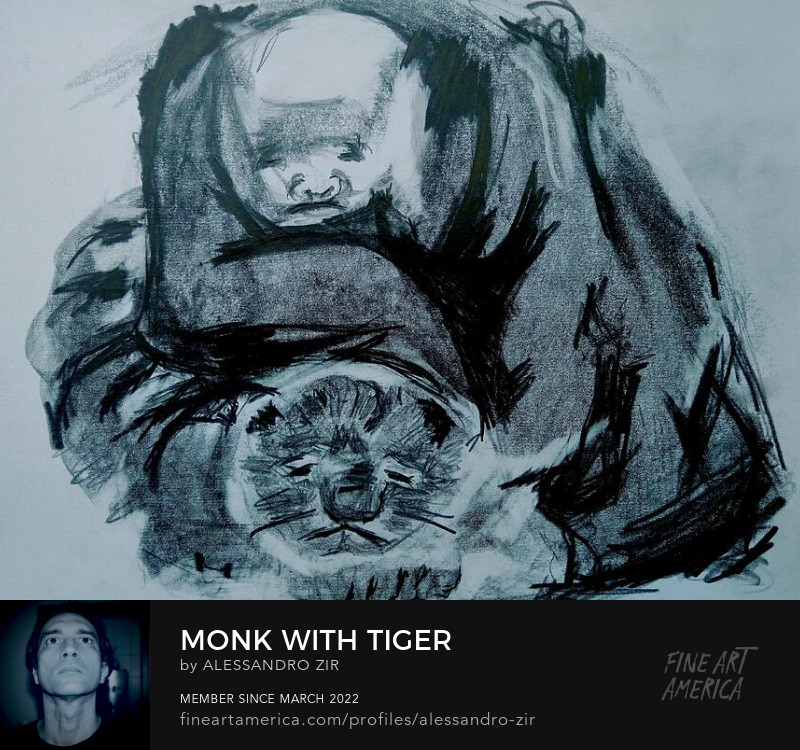
Gallous Agro-Rural-Pop Brazilian-Chinese Humour Constructivism (A/Z's Instagram post);
"Monk with Tiger", A/Z's Graphite & Pencil Drawing of a Medieval Chinese handscroll (original image: Two Minds in Harmony, in the manner of Shi Ke), available with other drawings and photographs at Fine Art America;
**************************************************************
"Notons seulement que la philosophie chinoise rend manifeste au plus haut point ce qui paraît être un trait central de toute ontologie analogique, à savoir la difficulté à distinguer en pratique, dans les composantes des existants, entre ce que relève de l'intériorité et ce qui relève de la physicalité. C'est ce qu'exprime cet aphorisme tiré d'un traité à peu près contemporain d'Aristote, le Hi ts'eu, 'les wou (êtres) sont faits de tsing et de k'i'. Par wou, il faut entendre chacun des types de choses animées et inanimées, un ensemble communément appelé les 'Dix Mille Essences' (wan wou), mais dont le nombre exact, calculé d'après les 64 hexagrammes servant à la divination, serait en fait de 11520, correspondant à autant de situations, d'états et d'emblèmes singuliers. Chaque wou est constitué d'émanations provenant du Ciel où règne le Souffle (k'i) et de la Terre qui produit les essences nourricières (tsing), de sorte que toute 'nature' (sing) est le résultat d'une combinaison et d'un dosage plus moins harmonieux et équilibrés entre des éléments hétérogènes qui procèdent de l'Eau, du Feu, du Bois, du Métal, de la Terre."
Philippe Descola (Par-delà nature et culture)
"Cependant, rien n'égalait les nuances de Canton: le poisson désossé, les côtelettes sucrées, la tortue, le serpent sauté, le boeuf à l'huile d'huître—le Sud y déployait tout cet éventail de subtiles fadeurs que Bréhal était venu glaner, synonyme de civilisation."
"Si le petit enfant utilise pour faire du sens, ces tonalités qu'il est capable de discerner et de reproduire dès l'âge de six mois, c'est qu'il entre profondément dans le langage dès l'âge de six mois—voilà au moins qui est clair—et non pas à deux ans. Deux ans, comme le fera le petit Français, Anglais, Russe, etc... Alors, le petit Chinois est saisi très tôt par le système de la parole, il est éduqué et poli par les symboles depuis le lait maternel et avec le lait maternel... Je dis que tout petit Chinois est potentiellement un disciple du Tao-tö king: il se nourrit de sa mère comme des mots chantés, la musique lie le lait au language."
Olga (Les Samouraïs)
"On danse ave les artères et les veines. Ne croyez pas qu'il s'agisse d'une affaire de bras ou de jambes. Le sang se propulse ou reflue, puis vient un moment où le corps se transforme. Ce n'est pas qu'il disparaît, mais son rythme sanguin s'harmonise avec les figures imaginées de l'espace, le corps est tout l'espace, dedans et dehors pris ensemble et redécoupés, agrandis comme à l'infini, disséqués comme à l'infini... cette avenue, ici, ce fleuve et ces vieilles ou jeunes carapaces, à côté, avec leur air d'extasiés impassibles, m'ont fait découvrir quelque chose qu'une salle de gym à Paris ou à New York ne révélera jamais: sans intérieur ni extérieur, une harmonieuse circulation entre mon corps et le monde, qui métamorphose le monde en corps et le corps en espace sans bornes."
Hervé (Les Samouraïs)
"Je propose d'en revenir par le théâtre à une idée de la connaissance physique des images et des moyens de provoquer des transes, comme la médecine chinoise connaît sur toute l'étendue de l'anatomie humaine les points qu'on pique et qui régissent jusqu'aux plus subtiles fonctions."
A. Artaud (En finir avec les chefs-d'oeuvre)
"Et d'après des vieux Chinois le foie est le filtre de l'inconscient mais la rate est le répondant physique de l'infini."
A. Artaud (Le Rite du Peyotl chez les Tarahumaras)
"Sourire un peu asiatique"
André Masson (Propos sur le Surréalisme)
"No glot... C'lom Fliday..."
William S. Burroughs
**************************************************************
"'Returning to the state of infancy...' It was indeed one of the most ancient slogans of Taoism..." (: 25).
"... tien tao, 'turning nature upside down'"(: 26).
"...the keynote was to avoid excess in everything, to live the most healthy kind of life, to cultivate ataraxia" (: 29).
[contrast between "Buddhist acceptance of fate" and "the Taoist attitude... that people can do something actively and successfully about their life-span..." (: 46);]
"However we may judge their physiological theories now, there is no reason for doubting that under appropriate conditions they could perform miracles of restoring physical and mental health" (: 47).
"The first thing which must be said about the fundamental ideas of nei tan alchemy is that without giving serious attention to the ideology of the I Ching... there is no hope of understanding them" (: 52).
["going against nature", "exaltation of feminine qualities", "sublimation of intra-specific aggressiveness" (: 61);]
"...he who possesses abundant virtue may be likened to a babe; a man harbouring the fullness of tê in his mouth and bosom is protected by the spirits as if they were protecting a child... An infant does no hurt to any creature, nor does any creature hurt it. In a generation entirely peaceful, men are neither esteemed nor despised. Stinging creatures therefore then reverse their nature, and poisonous snakes do no harm to man" (: 132).
"The most important thing is simply to... breathe like an embryo (: 143)... Neither during exhalation nor inhalation should one hear with one’s ears the sound of the breathing, and one should make sure that more goes in than comes out. A wild goose feather may be placed in front of the nose and mouth..." (: 144).
"... the breathing became secondary to an imaginative voluntary circulation of the chi of the internal organs" (: 147).
["... the body should be exercised in every part but... this should not be over-done in any way... By stretching at the waist and moving the different joints to left and right one can make it difficult for people (to grow) old" (: 161);]
"It was only natural that Chinese Buddhism should have had a strong physical (: 166) exercise tradition of its own because it inherited much of Indian yoga technique" (: 169).
[Taoist influences on the development of the Naturphilosophie movement (: 175);]
[Goethe interest in Chinese ideas (: 177);]
"The way to get it is not to want it" (: 181).
"One of the most curious practices was the 'absorbing the image of the sun'" (: 183).
["Hsi Wang Mu... was a woman who obtained the Tao (of immortality) by nourishing the Yin (within her)..." (: 194);]
"This was simply that the essential procedure of coitus thesauratus could be effected by masturbation" (: 201).
[Ko Hung, Pao Phu Tzu book: "This is all nonsense, exaggerated talk of enchantments derived from the books of wizards and magicians... it has lost all relation with the facts. Some of it indeed is the work of licentious charlatans... There are obvious natural limits to these principles... once the essential rules are known, the benefits will increase in proportion with the number of copulations; but if one makes love without properly knowing this Tao, it is enough even to bring danger of quick and sudden death, as has been seen in one or two cases. All the essentials are contained in the old methods of Phêng Tsu..." (: 210);]
"Although from the Upanishads onwards the general Indian tendency had been to reject the phenomenal world as ephemeral, painful and illusory, for both Yoga and Samakhya the world was real and not illusion" (: 258).
"... the movement was both anti-ascetic (in the extreme sense of the word) and anti-speculative. In the Kalacakra Tantra a Buddha reveals that man’s own body is the true cosmos" (: 260).
"Let us now take a brief look at certain general characteristics of the yogistic systems, thinking particularly of relations with China and the physiological alchemists there. First, 'contrariness' as such. Liberation (mukti), in Indian thought, always had a flavour of 'going contrary to all normal human inclinations'" (: 261).
"There may be a remnant of the ancient shamanism complex here, with its ecstatic aerial voyages, its mastery of fire, and its changes in and out of animal forms" (: 262).
"... [the idea of going counter-current] was therefore entirely congruent with modern science and technology, which in so many ways have had to convince these later centuries that it is not always necessary to proceed 'in the way that God intended'" (: 292).
***Joseph Needham, Science and Civilization in China, vol. 2 (Cambridge, 1956).
"...peculiarly Chinese was the belief in a mysterious life force, ch'i, which pervades the universe and all it contains in a continuous circular course of waning and waxig, later to be defined as the eternal mutual interaction of dual cosmic forces, the positive (yang) and the negative (yin). It was believed that this life force followed a definite path that represented the supreme order of nature, later called tao... Those who lived in consonance with the natural order collected thereby a great amount of ch'i, which increased their tê, 'virtue' — to be understood in its original sense of magical power, mana. This tê was not the exclusive possession of man, also birds and beasts, plants, trees and stones were deemed to have it" (: 12).
"Since the king has a maximum of tê, he needs a large number of female partners to nourish and perpetuate it through sexual intercourse. The king has one queen (hou), three consorts (fu-jên), nine wives of the second rank (pin), twenty-seven wives of the third rank (shih-fu), and eighty-one concubines (yü-chi). These figures are fixed according to a hoary number-magic" (: 17).
"The unbroken line represented the positive, male force in accordance with the above-mentioned number-magic which had fixed odd numbers as expressive of positive and male forces. The broken line represented the negative, female force because even numbers stood for that element" (: 35).
"Fire easily flares up, but it is also easily extinguished by water; water, on the contrary, takes a long time to heat over the fire but it will also cool down very slowly. This is a true image of the actual difference in pre- and post-orgasm experience of man and woman. Chinese medicine, though weak in anatomical science, has always evinced a very shrewd appreciation of psychological factors" (: 38).
"According to the theory of yin and yang generating each other in an everycurrent circular movement, when yang is at its minimum it changes into ying; ying then grows and when it has reached its maximum it changes into yang. For yang harbours a yin element, and yin harbours the embryo of yang" (: 41).
"...intimate contact between two yang elements can not result in a total loss of vital force for either of them... It is praised if such a relationship inspired great artistic achievements. It may be added that while female homosexuality was widely spread, male homosexuality was rare in early times up till the Han dynasty; during that period it was at times deemed fashionable, and it seems to have flourished especially in the early part of the Liu-ch'ao period, and again during the Northern Sung dynasty (960-1127A.D)" (: 48).
"... since the Chinese considered the sexual act as part of the order of nature, and the exercise of it the sacred duty of every man and woman, it was never associated with a feeling of sin or moral guilt" (: 50).
"The Palace cult of the Han rulers was predominantly Taoist. It was intended to enhance the Emperor's position as Lord of the Universe, of super-human magical potency and longevity. The rulers surrounded themselves with Taoist alchemists and magicians, which engaged in the search for the Elixir of Life, and the quest for the Isles of the Immortals" (: 56).
"The first three Emperor, Kao-tsu (i.e. Liu Pang, the founder of the dynasty, 206-195 B.C.), Hui-ti (194-188 B.C.) and Wên-ti (179-157 B.C.) were pronouncedly bi-sexual; next to their regular intercourse with the uncounted haren-ladies, all three had relations with young men... Emperor Wên's homosexual proclivities were encouraged by his Taoist studies. He once dreamed that a boatman ferried him over to the Abode of the Immortals. When later he saw a good-looking young boatman called Têng T'ung who resembled the man seen in his dream, he made him his favourite boy-lover, and showered wealth and honour on him. This same Emperor sought assiduously for the Elixir of Life, and together with Taoist adepts engaged in various alchemistic experiments" (: 62).
"The last Emperor of the Former Han dynasty, Ai-ti (6-1 B.C.) had a number of boy-lovers, the best known of them was a certain Tung Hsien. Once when the Emperor was sharing his couch with Tung Hsien, the latter fell asleep lying across the Emperor's sleeve. When the Emperor was called away to grant an audience, he took his sword and cut off his sleeve rather than to disturb the sleep of his favourite. Hence the term tuan-hsiu 'the cut sleeve', has become a literary expression for homosexuality among man" (: 63).
"The ancient Chinese recognized that, apart from other advantages, the completion of the sexual act regulates the blood circulation and relaxes the nervous system (: 69). This is a train of thought where Confucianism and Taoism meet. It brings us to the subject of the handbooks of sex, and the Taoist attitude to sexual relations" (: 70).
"... the commentary states that all these three lived to an advanced age, and always looked like young men... 'He lived to the age of 150 years by practising the art of having sexual intercourse with women, as taught by Jung-ch'êng'... 'Then one's grey hair will turn black again and new teeth will replace those that have fallen out'" (: 71).
"...thereafter she would there let handsome young men drink good wine, and let them stay the night there with her, so that she could practise with them the art described in the book. When she had done so during thirty years, she looked younger still, as if she were only twenty" (: 75)
[handbooks of pictures of positions of the sexual act, given to daughters by parents "in Japan... till well into the 19th century" (: 76);]
"'The people of the present love trifling technical skills, they do not examine the profundity of Tao, they abandon the right and follow the false. They want to arrive at the goal quickly and thus find their path obstructed... And yet those who (really) desire to know the method of partaking of 'the medicine', will find it simple and easy to put into practice'" (: 81).
"... the great musician and philosopher Hsi K'ang (223-262 A.D.), and his bosom friend the poet Yüan Chi (210-263 A.D.). Their close friendship has become the classical example of similar male attachments among poets and artists of later ages — as for instance of the T'ang poets Li Po (701-762) and Mêng Hao-jan (689-740), and Po Chü-i (772-846) and Yüan Chên (779-831)" (: 91).
"Buddhism had been introduced into China in its Mahayanic form, including such magical aspects as that embodied in the Mantrayana, the 'Doctrine of Spells'. The Mantrayanic spells and charms proved to be attractive to both the Chinese literati and to the masses, it appealed to them as a kind of glorified Taoism. Buddhist monks acted as mediums, rain-makers, soothsayers and exorcists, and also Buddhist nuns engaged in these activities" (: 113).
"As soon as the scholar dares to write on this particular subject [sex] he is immediately ostracized. These facts are eloquent proof of how badly ensnarled Chinese literati of the Ch'ing period had become in their own sexual inhibitions" (: 123).
"Every man must regulate his emissions according to the condition of his vital essence. He must never force himself to emit semen. Every time he forces himself to reach orgasm he will harm his system. Therefore, strongly-built men of 15 years can afford to emit semen twice a day; thin ones once a day" (: 146).
"The Plain Girls said: 'The 16th day of the fifth moon is the day when Heaven and Earth mate. On this day one should refrain from sexual intercourse. Those who offend against this taboo will die within three years. In order to obtain proof one has but to suspend a piece of white cloth of one foot long on the evening of that day on the eastern wall (of one's house). If one inspects it the next morning one will find it covered with blood. Thus this day is taboo'" (: 151).
"'If one wishes a proof of the existence of incubi, on has but to repair alone to a marshy place far away in the mountains, in spring or autumn. One should stay there in a condition of complete tranquility, staring into space and concentrating one's thoughts on sexual intercourse. After three days and three nights, the body will suddenly become alternately cold and hot, the heart will be troubled and the vision blurred. Then, a man engaging in this experiment will meet a woman, and a woman a man. During sexual intercourse with such an incubus one will experience a pleasure that is greater than ever felt while copulating with an ordinary human being. But at the same time one will become subject to this disease which is difficult to cure'" (: 152).
"... reading the numerous poems that must date from this part of her life one obtains the impression that Yü Hsüan-chi was a passionate woman of strong personality who would not readily give up a man she was in love with. Her poetry is vigorous and original, she disdained the conventional clichés used in love-poetry of that time" (: 174).
"Every city took pride in its courtezans, and they figured largely in all public festivities" (: 180).
[sexual intercourse as playing a secondary role in men association with courtezans (: 181);]
"... jealous wives would often brand the faces of concubines out of spite, or as a punishment for some offense" (: 186).
"As to the ideal of male and female beauty of that time, one notices that the men cultivated a virile, even martial appearance. They liked thick beards, whiskers and long moustaches, and admired bodily strength. Both civilian and military officials practised archery, riding, sword fighting and boxing, and proficiency in these arts was highly praised" (: 188).
"Lady Wu Chao, who while still a consort of the Emperor T'ai-tsung established sexual relations with his son, the Crown-prince... When she had become Kao-tsung's favourite, she killed her own child and then falsely accused the Empress and another favourite of the Emperor of having murdered it" (: 190).
"'When a fox is fifty years old, it acquires the ability to change itself into a woman. At hundred it can assume the shape of a beautiful girl, or that of a sorcerer, or also that of an adult man who has sexual intercourse with women. At that age the fox knows what is happening at a distance of a thousand miles, it can derange the human mind and reduce a person to an imbecil. When the fox is a thousand years old, it is in communication with Heaven, and is then called Heavenly Fox'" (: 210)
"...the main point of [Vajrayanist] philosophy was that the ultimate Truth resides within the human body... For the body contains the 'spark of life' which through a meditative process can be made to flare up into a fire that destroys the duality of sex and thereby identifies the practitioner with the deity, making him one with the ultimate power in the universe, the Void" (: 340).
[tantrism highly consideration of woman: "... just as Taoism in China. Contrary to traditional Hinduism, Tantrism considered woman as equal to or even higher than man... one should bow to any female, be she a young girl, flushed with youth, or be she old, be she beautiful or ugly, good or wicked..." (: 346);]
"Having perused this summary of Buddhist and Sakta sexual mysticism, it will have struck the reader that there are striking parallels with modern psycho-analytical theories. It would indeed be worth while to consider Indian, Chinese and Tibetan sexual mysticism from the viewpoint of analytical psychology. Apart from such obvious resemblances as that of the libido to sakti in its sense of universal creative energy, the adept's raising of the 'serpent power' could be explained as an attempt at crossing the boundary between the individual consciousness and the collective unconscious... For on the adept's perilous journey into the unconscious he need solid support so as not to succumb to its centrifugal tendencies that might destroy his mind. It does not seem quite impossible that the adepts in sexual mysticism had come to realize dimly through their experiments the terrors of the unconscious" (: 346-47, n. 1).
"Since sexual mysticism based on the coitus reservatus flourished in China since the beginning of our era, whereas it was unknown in India, it seems obvious that this particular feature of the Vajrayana was imported into India from China, probably via Assam" (: 351).
****Robert Hans van Gulik, Sexual Life in Ancient China (Leiden: E. J. Brill, 1974).
See also:
