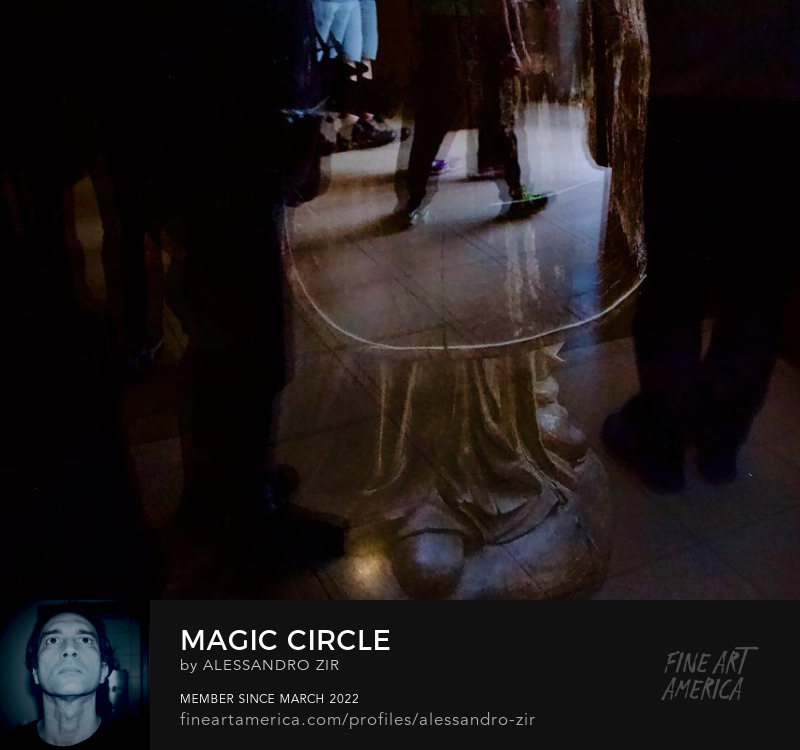
Photography taken by AZ at Musée d'Orsay/January 2018;
Clara Colosimo in Fellini's Prova d'orchestra;
Duchamp in Maya Deren's Witch's Cradle (1943);
The Dimension of Dali (Joan Úbeda & Susi Marquès, 2004);
György Ligeti: Étude No. 13 (L'escalier du diable) (Pierre Laurant Aimard/Youtube);
György Ligeti: Étude No. 13 (L'escalier du diable) (Gabriel Stern/Youtube);
György Ligeti: Étude No. 13 (L'escalier du diable) (Annie Qin/Youtube) [this video was taken out of Youtube];
Wave Function (Bozeman Science/Youtube);
De Broglie Wavelength (Khan Academy/Youtube);
Necessity of Complex Numbers (Barton Zwiebach, MIT/Youtube, Spring 2016) [an open minded, honest & serious nutshell explanation of a fundamental question in physics & mathematics many scientists would rather not talk about];
Imaginary Numbers Are Real: Riemann Surfaces (Welch Labs/Youtube);
But What is the Fourier Transform? (Grant Sanderson, 3Blue1Brown/Youtube);
Fourier Transforms (The Theory of Control/Youtube);
Convolution and the Fourier Series (Mark Newman/Youtube);
Como obter a Série de Fourier de uma função periódica? (Matemateca, Ester Velasquez/Youtube); Intro to the Fundamental Group: Algebraic Topology (Trefor Bazett & Tom Crawford/ Youtube);
Arquipélago dos Pombos Correios (o soverdouro) (A/Z, 2019) [I took this video out of Youtube, because I wanted to change it];
Arquipélago dos Pombos Correios (o soverdouro) (A/Z, 2019) [I took this video out of Youtube, because I wanted to change it];
The great abyss inframince [I took this video out of Youtube, because I wanted to change it];
en exergue (traditions to sift):
"E pois, te digo, as estrelas,
no céu imenso espalhadas,
são a metade e outro tanto
das mesmas por Deus criadas;
e, se imaginas que minto
na quantidade que dei,
te desafio a contá-las...
para ver que não errei!"
Cancioneiro Guasca
"I use the word approximation because a measuring mind can never finally measure nature."
"I use the word approximation because a measuring mind can never finally measure nature."
John Cage (Experimental Music)
"I'm giddy,—I'm stone blind,—I'm dying,—I a gone.—Help! Help! Help!—But hold..."
Tristram Shandy
"... but the Ping! is still there..."
David Mermin (What is wrong with this pillow?)
"... 'd' merely means 'a little bit of.'"
"Everything depends upon relative minuteness..."
Silvanus P. Thompson (Calculus Made Easy)
"But he wants The Cold like he wants His Junk—NOT OUTSIDE where it does him no good but INSIDE so he can sit around with a spine like a frozen hydraulic jack..."
"Because Fats' nerves were raw and peeled to feel the death spasms of a million cold kicks... Fats learned The Algebra of Need and survived..."
"Cure is always: Let Go! Jump!"
William S. Burroughs
"But these things explode first, a-and then you hear them coming in" [Slothrop].
"... this transmarginal leap, this surrender. Where ideas of the opposite have come together, and lost their oppositenes."
Thomas Pynchon (Gravity's Raimbow)
"... De la même façon, le coeur, sous l'effet d'une joie extraordinaire, se disperse à l'intérieur du corps et souffre une dissolution manifeste des esprits vitaux; celle-ci peut s'accentuer à un point tel que le coeur demeure privé de ce qui le fait fonctionner et que la vie s'éteint sous l'effet d'un tel excès de joie, comme le dit Galien au livre XII de la Méthode; au livre V du Lieu des affections, au livre II de La Cause des symptômes."
Rabelais, Gargantua (translation de Guy Demerson)
"Todo susto da galinha é porque estão sempre interrompendo o seu devaneio. A galinha é um grande sono."
Clarice Lispector (O Ovo e a Galinha)
"Il faut tout d'un coup voir la chose d'un seul regard, et non pas par progrès de raisonnement..."
Blaise Pascal (Différence entre l'esprit de géométrie et l'esprit de finesse)
"... toutes ces grandeurs sont divisibles à l'infini, sans tomber dans leurs indivisibles, de sorte qu'elles tiennent toutes le milieu entre l'infini et le néant."
Pascal (Fragments de l'esprit géométrique)
"Chance, to be precise, is a leap, provides a leap out of reach of one's own grasp of oneself."
John Cage (45' for a Speaker)
"Jagger had done two concerts and was really on the brink of collapse—but the kind of collapse that transcends into magic."
Patti Smith (Please Kill Me)
"K is a displacer—you are outside of your head, and everything, everything, is new..."
James St. James
"Reversal is the moving of the Way..."
Daodejing/40 (Edmund Ryden's translation)
"... silêncio, não se deve confundir com a pausa tradicional. Esta, também ausência de som, no entanto, é parte objetiva da estrutura formal, articulando e separando frases e motivos. Não é meio de expressão feito o silêncio, o qual tem de ser vivido subjetivamente e interpretado como tal, causando expectativa e tensão... o som não pode ser separado do espaço, aparentemente vazio, em que ele ocorre. Da mesma forma como as partículas não podem ser separadas do espaço que as circunda. É o som – não podendo ser considerado como entidade isolada – que determina e define a estrutura do espaço do silêncio. Porque tem que ser compreendido como condensação parcial de um campo sonoro contínuo e onipresente, presente por toda a parte. O silêncio deve ser considerado como fundo gerador de todos os sons e suas interações mútuas. O aparecimento e desaparecimento de sons, por seu lado, deve ser compreendido como formas de movimento desse mesmo campo e, se quiserem, de um holomovimento... A unificação dos conceitos, aparentemente opostos, som e silêncio, na estética relativista do impreciso e paradoxal, destrói, forçosamente, a noção tradicional de signos musicais isolados. Os signos sonoros da partitura tradicional, através da produção musical dos últimos trinta anos, dissolveram-se, cada vez mais, em padrões de probabilidade... "
Koellreutter (A Imagem do Mundo na Estética do Nosso Século)
"... we need to acknowledge the true complexity of music. Electronic music, in particular, is not merely a beat machine. It undulates (under envelope control), modulates (under low-frequency oscillator or LFO control), and triggers, as well as beats. These phenomena are the result of many simultaneous clocks and functions of time applied to pitch, timbre, space, etc... Moreover, broken and jagged beats, loops and diced loops are common currency of electronic music discourse. Electronic music can deploy overlapping polyrhythms generated by algorithms and advanced clocking schemes that ambulate around zones of rhythmic morphosis. Moreover, the local temporal context is always functioning within a hierarchy of larger timescales. In all these ways, the art of rhythm is far ahead of science’s ability to track it, much less explain it."
"Fundamental to the modern concept of rhythm is the recognition of the continuum between rhythm and tone (i.e., between the infrasonic frequencies—periodic and aperiodic rhythms—and the audible frequencies— pitched and unpitched tones). As mentioned previously, Henry Cowell described this relationship in 1930... More than two decades later, Karlheinz Stockhausen formulated another theory of the continuum between rhythm and pitch in the context of serial music."
"As Messiaen observed, when combining multiple simultaneous rhythms, one confronts 'neutralizing forces' that prevent clear perception of their superimposition. In general, these forces pertain to any kind of similarity between the various rhythmic voices, be it timbral, registral, harmonic, durational, or similarity of intensity and attack time. Messiaen was especially insistent on how isochronous pulsations destroy the polyrhythmic 'scaffolding' (échafaudage). Messiaen suggested that polyrhythms be articulated by polytonality and polymodality."
Curtis Roads, Composing Electronic Music
"... la science limite la conscience aux objets, elle ne mène pas à la conscience de soi (elle ne peut connaître le sujet qu'en le prenant pour un objet, pour une chose); mais elle contribue à l'éveil en habituant à la précision et en décevant: car elle admet elle-même ses limites, elle avoue l'impuissance où elle est de parvenir à la conscience de soi."
Georges Bataille (La Part Maudite)
"... la conception d’une quantité finie porte toujours sur l'objet du savoir, sur l’être qui est opposé au savoir et qui constitue l’objet de la connaissance; tandis que l’idée de l’infini... ne peut porter que sur les fonctions mêmes du savoir, où elle introduit la plus haute unité intellectuelle ou la plus haute signification dans la production même de la connaissance de la quantité."
Höené Wronski (Philosophie de l'Infini)
"The Divine Spirit found a sublime outlet in that wonder of analysis, that portent of the ideal world, that amphibian between being and not-being, which we call the imaginary root of negative unity."
Leibniz on imaginary numbers as quoted by Morris Kline (who has no understanding whatsoever of Leibniz's nature)
"Es treten in uns fortwährend neue Vorstellungs-massen auf, welche sehr rasch aus unserm Bewusstsein wieder verschwinden. Wir beobachten eine stetige Thätigkeit unserer Seele. Jedem Act derselben liegt etwas Bleibendes zu Grunde, welches sich bei besonderen Anlässen (durch die Erinnerung) als solches kundgiebt, ohne einen dauernden Einfluss auf die Erscheinungen auszuüben. Es tritt also fortwährend (mit jedem Denkact) etwas Bleibendes in unsere Seele ein, welches aber auf die Erscheinungswelt keinen dauernden Einfluss ausübt. Jedem Act unserer Seele liegt also etwas Bleibendes zu Grunde, welches mit diesem Act in unsere Seele eintritt, aber in demselben Augenblick aus der Erscheinungswelt völlig verschwindet. Von dieser Thatsache geleitet, mache ich die Hypothese, dass der Weltraum mit einem Stoff erfüllt ist, welcher fortwährend in die ponderablen Atome strömt und dort aus der Erscheinungswelt (Körperwelt) verschwindet..."
Bernhard Riemann (Neue mathematische Prinzipien der Naturphilosophie)
"Der phantasiestarke Mathematiker wird den Gebilden seines Denkens auch die Lebendigkeit der Anschauung einzuhauchen wissen, während Geister von schwächerer Flugkraft oder mehr abstrakter Richtung ihm in sein Reich konkreter Schöpfung und Belebung nicht zu folgen vermögen."
Felix Hausdorff (Das Raumproblem/Annalen der Naturphilosophie 1904)
"Mais ce que je veux faire voir, c'est que, dans cette déformation, le monde n'est pas demeuré semblable à lui-même ; les carrés sont devenus des rectangles ou des parallélogrammes, les cercles des ellipses, les sphères des ellipsoïdes. Et cependant nous n'avons aucun moyen de savoir si cette déformation est réelle."
Henri Poincaré (Science et Méthode)
"El Universo es una esfera cuyo centro está en todas partes y la periferia en ninguna [Nicolas de Cusa]: ¿podría extenderse al tiempo está concepción tradicional del infinito? ¡Qué mejor símbolo del fin de la confusión entre irreversibilidad y degradación! Reencontraríamos aqui la flecha del tiempo asociada a la inestabilidad y a la probabilidad, y ella no significaría ya evolución hacia la muerte térmica, hacia el fin de toda historia, sino posibilidad de un eterno volver a comenzar. El Universo sería creación continua, sucesión infinita de Universos que nacen por doquier y van hacia el infinito."
Spanish translation (by Javier García Sanz) from the end of chapter 7 of Prigogine & Stengers' Entre le temps et l'eternité [it is an ill-fated instance of the malignancy of this world that it happens I don't have the French original of this book, & shall therefore by my ashes stand forever indebted to the heroine soul (chaste star!) who peradventure send me, with all her fraternity, the French original of just this choicest morsel so I could definitely pen it down here as a seasonable kindness to our whole parish!]
"It is usual to assume that the curvatures are produced by those concrete somethings which we call mass, momentum, energy, pressure. In this way, we must concede a duality to nature; there would exist both matter and space-time, or, better still, matter and the metrical field of space-time. Einstein, when he elaborated his hypothesis of the cylindrical universe, attempted to remove this duality by proving that it was possible to attribute the entire existence of the metrical field, hence of space-time, to the presence of matter. This attitude led to a matter moulding conception of the universe, elevating matter over the metrical field of space-time. And as we recall, only when this attitude was adhered to could Mach's belief in the relativity of all motion be accepted. Eddington's attitude is just the reverse. He prefers to assume that the equations of gravitation are not equations in the ordinary sense of something being equal to something else. In his opinion they are identities. They merely tell us how our senses will recognise the existence of certain curvatures of space-time by interpreting them as matter, motion, and so on. In other words, there is no matter; there is nothing but a variable curvature of space-time."
"Since objects in equilibrium, such as rigid objects, electrons and atoms, all adjust themselves to the radius of curvature of the universe, it is only natural that results of greatest simplicity should be obtained when we select this radius or some definite fraction therof as a gauge at every point."
A. D'abro (The Evolution of Scientific Thought)
"Since Einstein introduced discontinuity into the study of light, and de Broglie the continuity of waves into the study of matter, it is impossible to maintain the old idea of domains of physical facts that are separate from one another. The physics of the continuous represents a mode of treatment by differential equations of physical facts. The physics of discontinuity represents a mode of treatment of the same facts by other methods: group theory, calculation of matrices, quantum statistics, etc. There thus exists a certain analogy between contemporary physics and contemporary mathematics, in that they offer each other the spectacle of facts amenable to being studied at the same time by the calculus of the continuous and by the calculus of the discontinuous."
Albert Lautman (Essay on the Unity of Mathematical Sciences, Simon B. Duffy's translation)
"Mathematics is constituted like physics: the facts to be explained were throughout history the paradoxes that the progress of reflection rendered intelligible by a constant renewal of the meaning of essential notions. Irrational numbers, the infinitely small, continuous functions without derivatives, the transcendence of e and of r, the transfinite had all been accepted by an incomprehensible necessity of fact before there was a deductive theory of them. They had the fate of these physical constants like c or h which were essential in an incomprehensible way in the most different domains, up until the genius of Maxwell, Planck and Einstein knew to see in the constancy of their value the connection of electricity and light, of light and energy."
Albert Lautman (Essay on the Notions of Structure and Existence in Mathematics, Simon B. Duffy's translation [it is ALSO an ill-fated instance of the malignancy of this world that it happens I don't have the French original of Lautman's essays, & shall therefore by my ashes stand forever indebted to the heroine soul (chaste star!) who peradventure send me, with all her fraternity, the French original of just at least these choicest morsels so I could definitely pen them down here as a seasonable kindness to our whole parish!])
"The continuum is one of the most complex concepts that humanity has had to decipher, not only in its technical, internal behavior, inside culture, but also in its constant, external entangling with the cosmos. Like Proteus, the sea god which changed his appearance at will, the continuum moves between the physical world and abstract ideals, between a subtle phaneron and wide hierarchical ramifications in mathematical models, between the most concrete biological evolution and arbitrary completions of discrete breaks. On its hand, a logic of continuity has to propose adequate signs, structures and rules to handle an important part of those passages. The triple action of semeiotics (syntactics, semantics, pragmatics) has to be put at work, in order to understand the global and local forces which shape the ongoing logical passages over the continuum."
"... la majorité est travaillé par une minorité proliférante et non dénombrable qui risque de détruire la majorité dans son concept même, c'est-à-dire en tant qu'axiome... le étrange concept de non-blanc ne constitue pas un ensemble dénombrable... Le propre de la minorité, c'est de faire valoir la puissance du non-dénombrable, même quand elle est composée d'un seul membre. C'est la formule des multiplicités. Non-blanc, nous avons tous à le devenir, que nous soyons blancs, jaunes ou noirs."
Deleuze & Guattari (Mille plateaux)
"De telles limites ne valent pas par la valeur empirique qu'elles prennent seulement dans des systèmes de coordonnées, elles agissent d'abord comme la condition de ralentissement primordial qui s'étend par rapport à l'infini sur toute l'échelle des vitesses correspondantes, sur leurs accélérations ou ralentissements conditionnés. Et ce n'est pas seulement la diversité de ces limites qui autorise à douter de la vocation unitaire de la science; c'est chacune en effet qui engendre pour son compte des systèmes de coordonnées hétérogènes irréductibles, et impose des seuils de discontinuité..."
Deleuze & Guattari (Qu'est-ce que la philosophie?)
"The equation to which Deleuze refers is the meromorphic function, which is a differential equation or function of a differential relation determined according to the Weierstrassian approach, from which the essential singularity and therefore the composite function are determined according to Poincaré’s qualitative approach. This form of integration is again characterised from the local point of view, by what Deleuze describes as an original process of différenciation."
Simon Duffy (The Mathematics of Deleuze's differential logic and metaphysics, Virtual Mathematics)
"... temporalité intemporelle, à une durée insaisissable: ce qu'on ne peut stabiliser, établir, appréhender, prendre mais aussi bien ce qu'on ne peut comprendre, ce que l'entendement, le sens commun et la raison ne peuvent begreifen, saisir, concevoir, entendre, médiatiser, donc non plus nier ou dénier, entraîner dans le travail du négatif, faire travailler..."
Jacques Derrida (Donner la mort)
"This relative freedom of a hero does not violate the strict specificity of the construction, just as the specificity of a mathematical formula is not violated by the presence of irrational or transfinite quantities."
Mikhail Bakhtin (Problems of Dostoevsky's Poetics, Caryl Emerson translation)
"... the term quantum mechanics is very much a misnomer. It should, perhaps, be called quantum nonmechanics..."
David Bohm
"Ich komme aus Höhen, die kein Vogel je erflog, ich kenne Abgründe, in die noch kein Fuß sich verirrt hat..."
"Vor mir giebt es diese Umsetzung des dionysischen in ein philosophisches Pathos nicht."
"... ein vollkommnes Ausser-sich-sein mit dem distinktesten Bewusstsein einer Unzahl feiner Schauder und Überrieselungen bis in die Fusszehen; eine Glückstiefe, in der das Schmerzlichste und Düsterste nicht als Gegensatz wirkt, sondern als bedingt, als herausgefordert, sondern als eine nothwendige Farbe innerhalb eines solchen Lichtüberflusses; ein Instinkt rhythmischer Verhältnisse, der weite Räume von Formen überspannt..."
Nietzsche
"Note the parallels between ordinary awareness, classical physics, and the natural and counting integers..."
Dean Radin (Real Magic)
"And though we may string ever so many clauses into a single compound sentence, motion leaks everywhere, like electricity from an exposed wire."
Ezra Pound (Chinese Character as a Medium for Poetry)
"Eighteenth-century masters achieved most pleasing effects with forgrounds of warm brown and fading distances of cool, silvery blues... Constable wanted to try out the effect of respecting the local color of grass somewhat more, in his Wivenhoe Park he is seen pushing the range more in the direction of bright greens. Only in the direction of, it is a transposition, not a copy."
Ernst H. Gombrich (Art and Illusion)
"Oboukhoff acumule alors en un étroit espace les demi-tons; la sensation est déchirante, horripilante... Avec le glissando, c'est tout l'infini du monde sonore qui fait irruption dans la musique tempérée..."
Boris de Schloezer (1925)
Ernst H. Gombrich (Art and Illusion)
"Oboukhoff acumule alors en un étroit espace les demi-tons; la sensation est déchirante, horripilante... Avec le glissando, c'est tout l'infini du monde sonore qui fait irruption dans la musique tempérée..."
Boris de Schloezer (1925)
"É a luz que dá o salto e cria toda mágica do espetáculo."
Ney Matogrosso
"Ihr verehrt mich: aber wie, wenn eure Verehrung eines Tages umfällt?"Ney Matogrosso
"Ich komme aus Höhen, die kein Vogel je erflog, ich kenne Abgründe, in die noch kein Fuß sich verirrt hat..."
"Vor mir giebt es diese Umsetzung des dionysischen in ein philosophisches Pathos nicht."
"... ein vollkommnes Ausser-sich-sein mit dem distinktesten Bewusstsein einer Unzahl feiner Schauder und Überrieselungen bis in die Fusszehen; eine Glückstiefe, in der das Schmerzlichste und Düsterste nicht als Gegensatz wirkt, sondern als bedingt, als herausgefordert, sondern als eine nothwendige Farbe innerhalb eines solchen Lichtüberflusses; ein Instinkt rhythmischer Verhältnisse, der weite Räume von Formen überspannt..."
Nietzsche
"A profound epistemological analysis of certain quantum-mechanical principles seems to suggest that the traditional conceptions of space and time are perhaps not the most suitable frame for the description of microphysical processes... In his discussion of electron transitions between stationary states within the atom, Niels Bohr already called such processes 'transcending the frame of space and time.'"
"Les données de nos perceptions nous conduisent à construire un cadre de l'espace et du temps où toutes nos observations peuvent se localiser. Mais le progrès de la Physique quantique nous amènent à penser que notre cadre de l'espace et du temps [as classically or ordinarily understood] n'est pas adéquat à la véritable description des réalités de l'échelle microscopique" [Louis de Broglie]."
"Should it become evident that Mach's Program cannot be satisfied within the general theory of relativity perhaps merely because the energy-momentum tensor which caracterizes matter presupposes already metrical magnitudes: in other words, because matter cannot be understood apart from knowledge of space-time, then matter as the source of the field will become part of the field. On the basis of such a unified field theoretic conception as proposed for example by J. Callaway, the field itself would constitute the ultimate, and in this sense absolute, datum of physical reality"
"As Salecker and Wigner rightly remarked, the concepts of rigid reference frames or of (practically) rigid rods as conventionally defined and taken as the basis for the construction of space-time metric and for the physical interpretation of the Lorentz covariance cannot be meaningfully applied in the quantal world of elementary particles."
Max Jammer's Concepts of Space (Dover 1993)
"In Grothendieck’s work, objects tend to be situated over certain ‘bases’ (the sheaf over its underlying topological space, the scheme over its spectrum), and many important problems arise when base changes are carried out."
"The term 'field' was first introduced into science by Michael Faraday in the 1840s, in connection with electricity and magnetism. His key insight was that attention should be focused on the space around a source of energy, rather than on the source of energy itself. In the nineteenth century the field concept was confined to electromagnetism and light. It was extended to gravitation by Einstein in his general theory of relativity in the 1920s. According to Einstein, the entire universe is contained within the universal gravitational field, curved in the vicinity of matter. Moreover, through the development of quantum physics, fields are now thought to underlie all atomic and subatomic structures... Fields are inherently holistic. They cannot be sliced up into bits, or reduced to some kind of atomistic unit; rather, fundamental particles are now believed to arise from fields..."
Rupert Sheldrake's Seven Experiments that could change the world
"The uncertainty principle of Werner Heisenberg suggests... that the vacuum is not empty. According to the principle, uncertainty about the energy of a system increases as it is examined on progressively shorter time scales. Particles may violate the law of the conservation of energy for unobservably brief instants; in effect, they may materialize from nothingness. In QED [Quantum Electrodynamics] the vacuum is seen as a complicated and seething medium in which pairs of charged "virtual" particles, particularly electrons and positrons, have a fleeting existence. These ephemeral vacuum fluctuations are polarizable just as are the molecules of a gas or a liquid. Accordingly QED predicts that in a vacuum too electric charge will be screened and effectively reduced at large distances..."
Chris Quigg's Elementary Particles and Forces (Scientific American, vol. 252, n. 4, 1985, pp. 84-95)
"Bohm and Hiley (1984) generalized the Penrose twistor theory to a Clifford algebra, paving the way for a description which allows continuous space-time to emerge from a deeper pre-space they call an implicate order. Bohm (1986) further proposed that the “ex-plicate” space and time that we consciously experience is likewise projected from its enfoldment in deeper implicate orders. In neural terms what becomes interesting here is Pribram’s (1991) holographic theory of neural memory, for the hologram (where information about the whole is stored in each part) is a paradigmatic example of an implicate order (of course, similar ideas have been explored in connection with artificial neural networks)..."
"Piaget describes how, when children are asked to draw a map of the local area around their home and are asked to position the playground, school, ice cream shop, dentist etc., they place the ice cream shop and the playground close to home, but will place the dentist and the school far from home, regardless of their actual physical distance from their home. The children are using a neighbourhood relation which has to do with pleasure and not physical distance. Thus by generalising the notion of neighbourhood, it is possible to have many different orders on the same set of points depending on what is taken to be the relevant criterion for the notion of neighbourhood in a particular context. Thus our description becomes context dependent and not absolute. This is very important both for thought and quantum theory... The importance of context in quantum theory has only recently begun to emerge, although it was always implicit in Bohr’s notion of wholeness. However in the Bohm interpretation context dependence becomes crucial..."
"Bohm notes that if we try to analyze a thought into smaller and smaller elements we eventually come to a point where further analysis seems impossible. Analogously, some of the essential properties of a quantum system (e.g. whether it is a wave or a particle) depend on its indivisible and incompletely controllable connections with surrounding objects. This suggests that both thought and quantum phenomena are characteristic of a radical type of wholeness, unanalyzability and context-dependence..."
"... in the 1950s one reaction against the failure of field theory in strong-interaction physics was to turn away from intractable Feynman diagrams towards the transition probabilities themselves—perhaps at this level of analysis some sense could be made of the strong interaction... the entire array of probabilities covering transitions between all conceivable initial and final states was known as Scattering- or S-matrix..."
Andrew Pickering's Constructing Quarks (Chicago, 1984);
"... it is the subjective act of transcendental synthesis which transforms the chaotic array of sensual impressions into 'objective reality.' Shamelessly ignoring the objection that we are confounding ontological and empirical levels, here we must invoke quantum physics: it is the collapse of the quantum waves in the act of perception which fixes quantum oscillations into a single objective reality. And, furthermore, this point must be universalized: every figure of reality is rooted in a determinate standpoint. Even at a level closer to us, we know how different 'reality' appears to a hog or a bird, starting with the different tapestry of colors: each living being perceives (and interacts with) its own 'reality.' And one should push this insight to the extreme of Cartesian doubt: the very notion of greatness should be relativized. How do we know that our Milky Way is not just a speck of dust in another universe?"
Slavoj Zizek (Haunted by A/Z, Feyerabend with vengeance & the New Wave)
**************************************************************
Too Manifestly a Obliquity (as I called it) &/or as my life and opinions are likely to make some noise in the world:
This is AGAINST your worship, Carlo Rovelli's dictum or pseudo-problem: "visto que tudo se atrai, a única maneira de um Universo finito não desmoronar sobre si mesmo é que se expanda" [Anglicé: since all things attract one another, the only way a finite Universe can avoid collapse is to expand] (A realidade não é o que parece, as indeed it is, p. 105)—but why should one use the term "finite" (or even "infinite") to describe a universe with no definite borders (like a 3-sphere, or something even more complex), which indeed had never been thought of at all? The infinite is not equivalent to the huge. The infinite is simply (according to Dedekind, a person of no small note and consequence) what can be matched up to its own parts (the only reason to deny this is hysteria, paradox-freakishness, state apoplexy & disquietude of the soul). The universe (the chaosmos) both expands & collapses, with the gross and more carnal parts included! As a whole and at the length of its space-time infinitesimals (or epsilon-delta limits, whatever), the macro/micro contractions, the revolving ruminations (what Rovelli confusedly calls "granulations," as if they were incompatible with any notion of continuity) of an autophagic real-virtual Einsteinian mollusk. If you have three fundamental constants (as Rovelli suggests, A realidade não é o que parece, p. 229), velocity [of light], information and Planck's length (c, ħ, ℓp), what matters is the relation among them (which might be revealed in established, finite proportions) not each one of their supposedly fixed (absolute) values (and even the relation might vary, fluctuate). I own I say this, of course, with all officious humility of heart devoted to the assistance merely of the inquisitive, but otherwise you behave like a very stupid painter arguing over the positive value of (what we call) green or brown in the transposition of tonal gradations to canvas.
**************************************************************
Main Hall (the good adventitious parts, by the destinies):
Time out of joints or the excessive solution (otherwise academically and sophistically called, after many successes & miscarriages, 'the measurement problem', as nine parts in ten of a man sense of his nonsense):
"If quantum state evolution proceeds via the Schrödinger equation or some other linear equation, then, as we have seen in the previous section, typical experiments will lead to quantum states that are superpositions of terms corresponding to distinct experimental outcomes. It is sometimes said that this conflicts with our experience, according to which experimental outcome variables, such as pointer readings, always have definite values. This is a misleading way of putting the issue, as it is not immediately clear how to interpret states of this sort as physical states of a system that includes experimental apparatus, and, if we can’t say what it would be like to observe the apparatus to be in such a state, it makes no sense to say that we never observe it to be in a state like that," Wayne Myrvold's "Philosophical Issues in Quantum Mechanics," Stanford Encyclopedia of Philosophy;
"... von Neumann makes the logical structure of quantum theory very clear by identifying two very different processes, which he calls process 1 and process 2... Process 2 is the analogue in quantum theory of the process in classic physics that takes the state of a system at one time to its state at a later time. This process 2, like its classic analogue, is local and deterministic. However, process 2 by itself is not the whole story: it generates a host of ‘physical worlds’, most of which do not agree with our human experience. For example, if process 2 were, from the time of the big bang, the only process in nature, then the quantum state (centre point) of the moon would represent a structure smeared out over a large part of the sky, and each human body–brain would likewise be represented by a structure smeared out continuously over a huge region. Process 2 generates a cloud of possible worlds, instead of the one world we actually experience...," Jeffrey M. Schwartz's, Henry P. Stapp's and Mario Beauregard's "Quantum physics in neuroscience and psychology: a neurophysical model of mind–brain interaction," Philosophical Transactions of the Royal Society (2005);
"... a seminal discovery by Heisenberg... in order to get a satisfactory quantum generalization of a classic theory one must replace various numbers in the classic theory by actions (operators). A key difference between numbers and actions is that if A and B are two actions then AB represents the action obtained by performing the action A upon the action B. If A and B are two different actions then generally AB is different from BA: the order in which actions are performed matters. But for numbers the order does not matter: AB=BA. The difference between quantum physics and its classic approximation resides in the fact that in the quantum case certain differences AB–BA are proportional to a number measured by Max Planck in 1900, and called Planck’s constant. Setting those differences to zero gives the classic approximation," Jeffrey M. Schwartz's, Henry P. Stapp's and Mario Beauregard's "Quantum physics in neuroscience and psychology: a neurophysical model of mind–brain interaction," Philosophical Transactions of the Royal Society (2005);
**************************************************************
"This was on Friday afternoon. Saturday morning I awoke early and read the two papers. Bohm, in simple clear language, declared that indeed there were conceptual problems in both macro- and microphysics, and that they were not to be swept under the carpet... And, further, Bohm suggested that the root of those problems was the fact that conceptualizations in physics had for centuries been based on the use of lenses which objectify (indeed the lenses of telescopes and microscopes are called objectives). Lenses make objects, particles," Karl Pribram's "The Implicate Brain";
"An equally important step in understanding came at a meeting at the University of California in Berkeley, in which Henry Stapp and Geoffrey Chew of the Department of Physics pointed out that most of quantum physics, including their bootstrap formulations based on Heisenberg's scatter matrices, were described in a domain which is the Fourier transform of the spacetime domain. This was of great interest to me because Russell and Karen DeValois of the same university had shown that the spatial frequency encoding displayed by cells of the visual cortex was best described as a Fourier transform of the input pattern. ***The Fourier theorem states that any pattern, no matter how complex, can be analyzed into regular waveform components of different frequencies, amplitudes, and (phase) relations among frequencies. Further, given such components, the original pattern can be reconstructed. This theorem was the basis for Gabor's invention of holography," Karl Pribram's "The Implicate Brain";
**************************************************************
[***when different wave patterns meet, they add up to form new patterns; you can analyse complex wave patterns as if they were a superposition of more simple waves, which have, for instance a definite, uniforme wavelength; the illustration at left (see the picture much above) is taken from the site of professor John D. Norton (Pittsburg University): "Einstein for Everyone"; it is important to note (and it in no way becomes me to decide) that real wave patterns studied in physics are much more complex than this two dimensional representation, and that they are ultimately formed by something that is neither strictly speaking a wave nor a particle as these are classically understood; it shall also be laid before the reader in this very due time that not all John D. Norton's explanations given in the referred site seem very enlightening to me;]
From Maxwell's equations, we should expect (and indeed for the literal edification of the world) an infinite number of frequencies of electromagnetic waves (or radiation, which includes visible light, and waves whose frequencies are bellow the one which produces the red colour, such as radio waves, and also waves whose frequencies are above the one which produces the violet colour, such gama rays). All these electromagnetic waves travel under the heaven at what is called the speed of light (the frequencies can vary because the wavelength also varies proportionally) and constitute the electromagnetic spectrum. High frequency means also high photon energy. The photon energy is related to how single atoms of different material objects can absorb and emit electromagnetic waves, which happens always in quantum discrete amounts. As concrete musical instruments, atoms can produce oscillations only in certain restricted ways, and they do so very energetically. The physical production of what we perceive as forms and colours has to do, however, more directly with the way electromagnetic waves travel much more freely and continuously in space, through, for instance, air or water, interfering (constructively or destructively) with one another, interacting with molecules—and we are talking about electromagnetic waves of lower energy and frequencies, which are visible. What we see, although, isn't—to the very end of the world, everything.
"When we say that we wish to make sense of something we meant to put it into spacetime terms, the terms of Euclidean geometry, clock time, etc. The Fourier transform domain is potential to this sensory domain. The waveforms which compose the order present in the electromagnetic sea which fills the universe make up an interpenetrating organization similar to that which characterizes the waveforms "broadly cast" by our radio and television stations. Capturing a momentary cut across these airwaves would constitute their hologram. The broadcasts are distributed and at any location they are enfolded among one another. In order to make sense of this cacophany of sights and sounds, one must tune in on one and tune out the others. Radios and television sets provide such tuners. Sense organs provide the mechanisms by which organisms tune into the cacophany which constitutes the quantum potential organization of the elecromagnetic energy which fills the universe," Karl Pribram's "The Implicate Brain";
"... the cloud chamber photograph does not reveal a “solid” particle leaving a track. Rather it reveals the continual unfolding of process with droplets forming at the points where the process manifests itself. Since in this view the particle is no longer a point-like entity, the reason for quantum particle interference becomes easier to understand. When a particle encounters a pair of slits, the motion of the particle is conditioned by the slits even though they are separated by a distance that is greater than any size that could be given to the particle. The slits act as an obstruction to the unfolding process, thus generating a set of motions that gives rise to the interference pattern," Basil J. Hiley's "Mind and matter: aspects of the implicate order described through algebra" (in K. H. Pribram's and J. King's Learning as Self-Organisation, New Jersey, Lawrence Erlbaum Associates, 1996, pp. 569-86);
"Let us... ask what the algebraic structure tells you about the underlying phase space. Because the algebra is non-commutative there is no single underlying manifold. That is a mathematical result. Thus if we take the algebra as primary then there is no underlying manifold we can call the phase space. But we already know this. At present we say this arises because of the 'uncertainty principle,' but nothing is 'uncertain,'" Basil Hiley's "From the Heisenberg Picture to Bohm: a New Perspective on Active Information and its relation to Shannon Information" (in A. Khrennikov, Proc. Conf. Quantum Theory: reconsideration of foundations, Sweden, Växjö University Press, pp. 141-162, 2002);
"What Gelfand showed was that you could either start with an a priori given manifold and construct a commutative algebra of functions upon it or one could start with a given commutative algebra and deduce the properties of a unique underlying manifold. If the algebra is non-commutative it is no longer possible to find a unique underlying manifold. The physicist’s equivalent of this is the uncertainty principle when the eigenvalues of operators are regarded as the only relevant physical variables. What the mathematics of non-commutative geometry tells us is that in the case of a non-commutative algebra all we can do is to find a collection of shadow manifolds... The appearance of shadow manifolds is a necessary consequence of the non-commutative structure of the quantum formalism," Basil Hiley's "Phase Space Descriptions of Quantum Phenomena" (in A. Khrennikov, Quantum theory: Reconsiderations of Foundations, Vaxjo University Press, 2003);
"At their narrowest points, calcium ion channels are less than a nanometre in diameter... The narrowness of the channel restricts the lateral spatial dimension. Consequently, the lateral velocity is forced by the quantum uncertainty principle to become large. This causes the quantum cloud of possibilities associated with the calcium ion to fan out over an increasing area as it moves away from the tiny channel to the target region... This spreading of this ion wave packet means that the ion may or may not be absorbed on the small triggering site. Accordingly, the contents of the vesicle may or may not be released... the quantum state of the brain splits into a vast host of classically conceived possibilities, one for each possible combination of the release-or-no-release options at each of the nerve terminals... a huge smear of classically conceived possibilities," Jeffrey M. Schwartz's, Henry P. Stapp's and Mario Beauregard's "Quantum physics in neuroscience and psychology: a neurophysical model of mind–brain interaction," Philosophical Transactions of the Royal Society (2005);
"... waves make diffraction patterns precisely because multiple waves can be at the same place at the same time, and a given wave can be at multiple places at the same time... by definition particles are localized entities that take up space, they can be here or there, but not in two places at once. However it turns out that particles can produce diffraction patterns under specific circumstances... a given particle can be in a state of superposition... to be in a state of superposition between two positions, for exemple, is not to be here or there or even here and there, but rather it is to be indeterminately here-there. That is, it is not simply that the position is unknown, but rather there is no fact of the matter to whether it is here or there... it is a matter of ontological indeterminacy and not merely epistemological uncertainty... patterns of difference... are arguably at the core or what matter is and are at the heart of how quantum physics understands the world... the quantum probabilities are calculated by taken account of all the possible paths connecting the points. In other words, a given particle that starts out here and winds up there is understood as is understood to be in a superposition of all possible paths between two points. Or in its four dimensional quantum field theory elaboration, all possible space-time histories... the very meaning of superposition is that all possible histories are happening together, they all coexist and mutually contribute to this overall pattern or else there wouldn't be a diffraction pattern..." Karen Barad's "Troubling Time's & Ecologies of Nothingness," European Graduate School Video Lectures (YouTube), my transcription;
"Quantum physics opens up another possibility beyond the relatively familiar phenomena of spatial diffraction, namely, temporal diffraction. The existence of temporal diffraction is due to a less well-known indeterminacy principle than the usual position/momentum indeterminacy principle... something call the energy/time indeterminacy principle. This indeterminacy principle plays a key role in quantum field theory... temporalities are not merely multiple, but rather temporalities are specifically entangled and threaded through one another such that there is no determinate answer to the question what time is it? Karen Barad's "Troubling Time's & Ecologies of Nothingness," European Graduate School Video Lectures (YouTube), my transcription;
"During the waning decades of the 20th century, the most murdering century by some accounts in history, the notion that the past might be open to revision through a quantum erasure came to the fore. The quantum erasure experiment is a variation of the two slit diffraction experiment, an experiment which Feynman said contains all the mysteries of quantum physics. Against this fantastic claim of the possibility of erasure, I will claim that in paying close attention to the material labours entailed the claim of erasure possibility fades, at least full erasure, while at the same time bringing to the forth a relational ontology sensibility to questions of time, memory and history... the nature of time and being, or rather time-being itself is in question and can't be assumed. What this experiment tells us is not simply that a given particle would have done something different in the past, but that the very nature of its being, its ontology, in the past remains open to future reworkings... In particular I argue that this experiment offers empirical evidence for a relational ontology or perhaps more accurately a hauntology as against a metaphysics of presence... Remarkably this experiment makes evident that entanglement survives the measurement process and further more that material traces of attempts at erasure can be found in tracing the entanglements... While the past is never finished, and the future is not what would unfold, the world holds or rather is the memories of its iterated reconfigurings" Karen Barad's "Troubling Time's & Ecologies of Nothingness," European Graduate School Video Lectures (YouTube), my transcription;
"If classical physics insists that the void has no matter and no energy, the quantum principle of ontological indeterminacy, and particularly the indeterminacy relation between energy and time, pose into question the existence of such a zero energy, zero matter state... the indeterminacy principle allows for fluctuations of the vacuum... the vacuum is far from empty, it is fill with all possible indeterminate yearnings of space-time mattering... we can understand vacuum fluctuation in terms of virtual particles. Virtual particles are the quanta of the vacuum fluctuations... the void is a spectral ground, not even nothing can be free of ghosts... there is infinite number of possibilities, but not everything is possible. The vacuum isn't empty but neither is anything in it... particles together with their antiparticles and pairs can be created out of the vacuum by putting the right amount of energy into the vacuum... So, similarly, particles together with their antiparticles and pairs can go back into the vacuum, emitting the excess energy" Karen Barad's "Troubling Time's & Ecologies of Nothingness," European Graduate School Video Lectures (YouTube), my transcription;
"... waves make diffraction patterns precisely because multiple waves can be at the same place at the same time, and a given wave can be at multiple places at the same time... by definition particles are localized entities that take up space, they can be here or there, but not in two places at once. However it turns out that particles can produce diffraction patterns under specific circumstances... a given particle can be in a state of superposition... to be in a state of superposition between two positions, for exemple, is not to be here or there or even here and there, but rather it is to be indeterminately here-there. That is, it is not simply that the position is unknown, but rather there is no fact of the matter to whether it is here or there... it is a matter of ontological indeterminacy and not merely epistemological uncertainty... patterns of difference... are arguably at the core or what matter is and are at the heart of how quantum physics understands the world... the quantum probabilities are calculated by taken account of all the possible paths connecting the points. In other words, a given particle that starts out here and winds up there is understood as is understood to be in a superposition of all possible paths between two points. Or in its four dimensional quantum field theory elaboration, all possible space-time histories... the very meaning of superposition is that all possible histories are happening together, they all coexist and mutually contribute to this overall pattern or else there wouldn't be a diffraction pattern..." Karen Barad's "Troubling Time's & Ecologies of Nothingness," European Graduate School Video Lectures (YouTube), my transcription;
"Quantum physics opens up another possibility beyond the relatively familiar phenomena of spatial diffraction, namely, temporal diffraction. The existence of temporal diffraction is due to a less well-known indeterminacy principle than the usual position/momentum indeterminacy principle... something call the energy/time indeterminacy principle. This indeterminacy principle plays a key role in quantum field theory... temporalities are not merely multiple, but rather temporalities are specifically entangled and threaded through one another such that there is no determinate answer to the question what time is it? Karen Barad's "Troubling Time's & Ecologies of Nothingness," European Graduate School Video Lectures (YouTube), my transcription;
"During the waning decades of the 20th century, the most murdering century by some accounts in history, the notion that the past might be open to revision through a quantum erasure came to the fore. The quantum erasure experiment is a variation of the two slit diffraction experiment, an experiment which Feynman said contains all the mysteries of quantum physics. Against this fantastic claim of the possibility of erasure, I will claim that in paying close attention to the material labours entailed the claim of erasure possibility fades, at least full erasure, while at the same time bringing to the forth a relational ontology sensibility to questions of time, memory and history... the nature of time and being, or rather time-being itself is in question and can't be assumed. What this experiment tells us is not simply that a given particle would have done something different in the past, but that the very nature of its being, its ontology, in the past remains open to future reworkings... In particular I argue that this experiment offers empirical evidence for a relational ontology or perhaps more accurately a hauntology as against a metaphysics of presence... Remarkably this experiment makes evident that entanglement survives the measurement process and further more that material traces of attempts at erasure can be found in tracing the entanglements... While the past is never finished, and the future is not what would unfold, the world holds or rather is the memories of its iterated reconfigurings" Karen Barad's "Troubling Time's & Ecologies of Nothingness," European Graduate School Video Lectures (YouTube), my transcription;
"If classical physics insists that the void has no matter and no energy, the quantum principle of ontological indeterminacy, and particularly the indeterminacy relation between energy and time, pose into question the existence of such a zero energy, zero matter state... the indeterminacy principle allows for fluctuations of the vacuum... the vacuum is far from empty, it is fill with all possible indeterminate yearnings of space-time mattering... we can understand vacuum fluctuation in terms of virtual particles. Virtual particles are the quanta of the vacuum fluctuations... the void is a spectral ground, not even nothing can be free of ghosts... there is infinite number of possibilities, but not everything is possible. The vacuum isn't empty but neither is anything in it... particles together with their antiparticles and pairs can be created out of the vacuum by putting the right amount of energy into the vacuum... So, similarly, particles together with their antiparticles and pairs can go back into the vacuum, emitting the excess energy" Karen Barad's "Troubling Time's & Ecologies of Nothingness," European Graduate School Video Lectures (YouTube), my transcription;
**************************************************************
Labyrinthine corridors, rooms (which appear at certain intervals and changes of the Moon):
"An equally important step in understanding came at a meeting at the University of California in Berkeley, in which Henry Stapp and Geoffrey Chew of the Department of Physics pointed out that most of quantum physics, including their bootstrap formulations based on Heisenberg's scatter matrices, were described in a domain which is the Fourier transform of the spacetime domain. This was of great interest to me because Russell and Karen DeValois of the same university had shown that the spatial frequency encoding displayed by cells of the visual cortex was best described as a Fourier transform of the input pattern. ***The Fourier theorem states that any pattern, no matter how complex, can be analyzed into regular waveform components of different frequencies, amplitudes, and (phase) relations among frequencies. Further, given such components, the original pattern can be reconstructed. This theorem was the basis for Gabor's invention of holography," Karl Pribram's "The Implicate Brain";
**************************************************************
[***when different wave patterns meet, they add up to form new patterns; you can analyse complex wave patterns as if they were a superposition of more simple waves, which have, for instance a definite, uniforme wavelength; the illustration at left (see the picture much above) is taken from the site of professor John D. Norton (Pittsburg University): "Einstein for Everyone"; it is important to note (and it in no way becomes me to decide) that real wave patterns studied in physics are much more complex than this two dimensional representation, and that they are ultimately formed by something that is neither strictly speaking a wave nor a particle as these are classically understood; it shall also be laid before the reader in this very due time that not all John D. Norton's explanations given in the referred site seem very enlightening to me;]
From Maxwell's equations, we should expect (and indeed for the literal edification of the world) an infinite number of frequencies of electromagnetic waves (or radiation, which includes visible light, and waves whose frequencies are bellow the one which produces the red colour, such as radio waves, and also waves whose frequencies are above the one which produces the violet colour, such gama rays). All these electromagnetic waves travel under the heaven at what is called the speed of light (the frequencies can vary because the wavelength also varies proportionally) and constitute the electromagnetic spectrum. High frequency means also high photon energy. The photon energy is related to how single atoms of different material objects can absorb and emit electromagnetic waves, which happens always in quantum discrete amounts. As concrete musical instruments, atoms can produce oscillations only in certain restricted ways, and they do so very energetically. The physical production of what we perceive as forms and colours has to do, however, more directly with the way electromagnetic waves travel much more freely and continuously in space, through, for instance, air or water, interfering (constructively or destructively) with one another, interacting with molecules—and we are talking about electromagnetic waves of lower energy and frequencies, which are visible. What we see, although, isn't—to the very end of the world, everything.
Does the continuum (infinitely divisible) preclude plurality? Does the discrete precludes unity? Of course no! Except for the lack of imagination of the purist & prudish. But thanks gosh, in philosophy we also have Leibniz's "Natura non facit saltus," and Peirce's synechism (everything is connected), the immemorial and unending, irreducible battles between the one and the many. Why should people be so afraid of a conundrum of straight lines, curves, and points (which besides going for these one- and two-dimensions, can be extrapolated to n-)? Infinitesimals, differentials, and limits, what is the real difference? Epsilon-delta definition (Cauchy, Bolzano, Weierstrass) and nonstandard analysis (Abraham Robinson) are all in the end perfectly compatible. Add to that synthetic differential geometry or the smooth infinitesimal (F. W. Lawvere), whatever! The actual infinite—everything else starts from it! Just don't be afraid of lingo—the science wars are an affair of securing university bonus (with advowson, rectory & parsonage) in times of economic havoc. And don't forget that continuity doesn't have to be only local, that is, the chaosmos is full of nonlocal connections, the innermost separations! What matters is attitude, not content or specific formulations.
["Whenever a point x is within δ units of c, f(x) is within ε units of L," graphic and definition from the Wikipedia's epsilon-delta entry (see the picture much above);]
["Infinitesimals (ε) and infinites (ω) on the hyperreal number line (1/ε = ω/1)," graphic and definition from Wikipedia's hyperreal number entry (see the picture much above;]
"Cusanus... took the circle to be an infinilateral regular polygon, that is, a regular polygon with an infinite number of (infinitesimally short) sides... The idea of considering a curve as an infinilateral polygon was employed by a number of later thinkers, for instance, Kepler, Galileo and Leibniz... Traditionally, geometry is the branch of mathematics concerned with the continuous and arithmetic (or algebra) with the discrete. The infinitesimal calculus that took form in the 16th and 17th centuries, which had as its primary subject matter continuous variation, may be seen as a kind of synthesis of the continuous and the discrete, with infinitesimals bridging the gap between the two. The widespread use of indivisibles and infinitesimals in the analysis of continuous variation by the mathematicians of the time testifies to the affirmation of a kind of mathematical atomism which, while logically questionable, made possible the spectacular mathematical advances with which the calculus is associated. It was thus to be the infinitesimal, rather than the infinite, that served as the mathematical stepping stone between the continuous and the discrete," John L. Bell's "Continuity and Infinitesimals" (Stanford Encyclopedia of Philosophy) [I like this passage very much, and this is a very useful article, but it shall also be laid before the reader in this very due time that I'm not subscribing in detail to all ideas Bell developed there];
["Infinitesimals (ε) and infinites (ω) on the hyperreal number line (1/ε = ω/1)," graphic and definition from Wikipedia's hyperreal number entry (see the picture much above;]
"Cusanus... took the circle to be an infinilateral regular polygon, that is, a regular polygon with an infinite number of (infinitesimally short) sides... The idea of considering a curve as an infinilateral polygon was employed by a number of later thinkers, for instance, Kepler, Galileo and Leibniz... Traditionally, geometry is the branch of mathematics concerned with the continuous and arithmetic (or algebra) with the discrete. The infinitesimal calculus that took form in the 16th and 17th centuries, which had as its primary subject matter continuous variation, may be seen as a kind of synthesis of the continuous and the discrete, with infinitesimals bridging the gap between the two. The widespread use of indivisibles and infinitesimals in the analysis of continuous variation by the mathematicians of the time testifies to the affirmation of a kind of mathematical atomism which, while logically questionable, made possible the spectacular mathematical advances with which the calculus is associated. It was thus to be the infinitesimal, rather than the infinite, that served as the mathematical stepping stone between the continuous and the discrete," John L. Bell's "Continuity and Infinitesimals" (Stanford Encyclopedia of Philosophy) [I like this passage very much, and this is a very useful article, but it shall also be laid before the reader in this very due time that I'm not subscribing in detail to all ideas Bell developed there];
"... science needs calculus; calculus needs the continuum; the continuum needs a very careful definition; and the best definition requires there to be actual infinities (not merely potential infinities) in the micro-structure and the overall macro-structure of the continuum... Informally expressed [for Dedekind], any infinite set can be matched up to a part of itself; so the whole is equivalent to a part. This is a surprising definition because, before this definition was adopted, the idea that actually infinite wholes are equinumerous with some of their parts was taken as clear evidence that the concept of actual infinity is inherently paradoxical... [Cantor's] new idea [similar to Dedekind's] is that the potentially infinite set presupposes an actually infinite one. If this is correct, then Aristotle’s two notions of the potential infinite and actual infinite have been redefined and clarified," Bradley Dowden's "The Infinite" (Internet Encyclopedia of Philosophy) [I like this passage very much, and this is a very useful article, but it shall also be laid before the reader in this very due time that I'm not subscribing in detail to all ideas Dowden developed there];
**************************************************************
**************************************************************
"... in Quantum Electrodynamics... processes of much greater complexity [than a simple electron-electron scattering] could intervene in the scattering process. For example, the exchanged photon could convert to an electron-positron pair which would subsequently recombine... or one of the incoming electrons might emit a photon and reabsorb it on the way out... in general, the exchange of arbitrarily large numbers of photons, electrons and positrons can contribute to electromagnetic interactions... very complicated multiparticle exchanges have to be taken into account in the analysis of physical systems. Indeed, no exact solutions to the Quantum Electrodynamics are known, nor have such solutions ever been shown rigorously to exist [but precise approximations are possible]," Andrew Pickering's Constructing Quarks (p. 63);
"... in quantum field theory all forces are mediated by particle exchange... It is equally important to stress that the exchanged particles... are not observable... To explain why this is so, it is necessary to make a distinction between 'real' and 'virtual' particles... particles with unphysical values of energy and momentum are said to be 'virtual' or 'off mass-shell' particles. In classical physics they could not exist at all... In quantum physics, in consequence of the Uncertainty Principle, virtual particles can exist, but only for an infinitesimal and experimentally undetectable length of time. In fact, the lifetime of a virtual particle is inversely dependent upon how far its mass diverges from its physical value," Andrew Pickering's Constructing Quarks (p. 64-65);
"In quantum mechanics the particles themselves can be represented as fields. An electron, for example, can be considered a packet of waves with some finite extension in space. Conversely, it is often convenient to represent a quantum mechanical field as if it were a particle. The interaction of two particles through their interpenetrating fields can then be summed up by saying the two particles exchange a third particle, which is called the quantum of the field. For example, when two electrons, each surrounded by an electromagnetic field, approach each other and bounce apart, they are said to exchange a photon, the quantum of the electromagnetic field. The exchanged quantum has only an ephemeral existence... The larger their energy, the briefer their existence. The range of an interaction is related to the mass of the exchanged quantum. If the field quantum has a large mass, more energy must be borrowed in order to support its existence, and the debt must be repaid sooner lest the discrepancy be discovered. The distance the particle can travel before it must be reabsorbed is thereby reduced and so the corresponding force has a short range. In the special case where the exchanged quantum is massless [such as a photon] the range is infinite," Gerard 't Hooft's "Gauge Theories of the Forces between Elementary Particles" (Scientific American, vol. 242, n. 6, 1980, pp. 104-141);
"... in quantum field theory all forces are mediated by particle exchange... It is equally important to stress that the exchanged particles... are not observable... To explain why this is so, it is necessary to make a distinction between 'real' and 'virtual' particles... particles with unphysical values of energy and momentum are said to be 'virtual' or 'off mass-shell' particles. In classical physics they could not exist at all... In quantum physics, in consequence of the Uncertainty Principle, virtual particles can exist, but only for an infinitesimal and experimentally undetectable length of time. In fact, the lifetime of a virtual particle is inversely dependent upon how far its mass diverges from its physical value," Andrew Pickering's Constructing Quarks (p. 64-65);
"In quantum mechanics the particles themselves can be represented as fields. An electron, for example, can be considered a packet of waves with some finite extension in space. Conversely, it is often convenient to represent a quantum mechanical field as if it were a particle. The interaction of two particles through their interpenetrating fields can then be summed up by saying the two particles exchange a third particle, which is called the quantum of the field. For example, when two electrons, each surrounded by an electromagnetic field, approach each other and bounce apart, they are said to exchange a photon, the quantum of the electromagnetic field. The exchanged quantum has only an ephemeral existence... The larger their energy, the briefer their existence. The range of an interaction is related to the mass of the exchanged quantum. If the field quantum has a large mass, more energy must be borrowed in order to support its existence, and the debt must be repaid sooner lest the discrepancy be discovered. The distance the particle can travel before it must be reabsorbed is thereby reduced and so the corresponding force has a short range. In the special case where the exchanged quantum is massless [such as a photon] the range is infinite," Gerard 't Hooft's "Gauge Theories of the Forces between Elementary Particles" (Scientific American, vol. 242, n. 6, 1980, pp. 104-141);
"It was not immediately apparent that quantum electrodynamics could qualify as a physically acceptable theory. One problem arose repeatedly in any attempt to calculate the result of even the simplest electromagnetic interactions, such as the interaction between two electrons. The likeliest sequence of events in such an encounter is that one electron emits a single virtual photon and the other electron absorbs it. Many more complicated exchanges are also possible, however; indeed, their number is infinite. For example, the electrons could interact by exchanging two photons, or three, and so on. The total probability of the interaction is determined by the sum of the contributions of all the possible events... Perhaps the best defense of the theory is simply that it works very well. It has yielded results that are in agreement with experiments to a n accuracy of about one part in a billion, which makes quantum electrodynamics the most accurate physical theory ever de vised," Gerard 't Hooft's "Gauge Theories of the Forces between Elementary Particles" (Scientific American, vol. 242, n. 6, 1980, pp. 104-141);
"If an electron enters a medium composed of molecules that have positively and negatively charged ends, for example, it will polarize the molecules. The electron will repel their negative ends and attract their positive ends, in effect screening itself in positive charge. The result of the polarization is to reduce the electron's effective charge by an amount that in creases with distance... The uncertainty principle of Werner Heisenberg suggests... that the vacuum is not empty. According to the principle, uncertainty about the energy of a system increases as it is examined on progressively shorter time scales. Particles may violate the law of the conservation of energy for unobservably brief instants; in effect, they may materialize from nothingness. In QED [Quantum Electrodynamics] the vacuum is seen as a complicated and seething medium in which pairs of charged "virtual" particles, particularly electrons and positrons, have a fleeting existence. These ephemeral vacuum fluctuations are polarizable just as are the molecules of a gas or a liquid. Accordingly QED predicts that in a vacuum too electric charge will be screened and effectively reduced at large distances," Chris Quigg's Elementary Particles and Forces (Scientific American, vol. 252, n. 4, 1985, pp. 84-95);
"A nuvem de probabilidades que acompanha os elétrons entre uma interação e outra é um pouco parecida com um campo. Mas os campos de Faraday e Maxwell, por sua vez, são feitos de grãos: os fótons. Não apenas as partículas estão em certo sentido difusas no espaço como campos, mas também os campos interagem como partículas. As noções de campo e de partícula, separadas por Faraday e Maxwell, acabam convergindo na mecânica quântica. A forma como isso acontece na teoria é elegante: as equações de Dirac determinam quais valores cada variável pode assumir. Aplicadas à energia das linhas de Faraday, dizem-nos que essa energia pode assumir apenas certos valores e não outros... As ondas eletromagnéticas são de fato vibrações das linhas de Faraday, mas também, em pequena escala, enxames de fótons... Por outro lado, também os elétrons e todas as partículas de que é feito o mundo são 'quanta' de um campo... semelhante ao de Faraday e Maxwell," Carlo Rovelli's A realidade não é o que parece (Objetiva, 2014, p. 125);
"A 'nuvem' que representa os pontos do espaço onde é provável encontrar o elétron é descrita por um objeto matemático chamado 'função de onda.'O físico austríaco Erwin Schrödinger escreveu uma equação que mostra como essa função de onda evolui no tempo. Schrödinger esperava que a 'onda' explicasse as estranhezas da mecânica quântica... Ainda hoje alguns tentam entender a mecânica quântica pensando que a realidade é a onda de Schrödinger. Mas Heisenberg e Dirac logo compreenderam que esse caminho é equivocado. A função [de onda] não está no espaço físico, está em um espaço abstrato formado por todas as possíveis [virtuais!] configurações do sistema... A realidade do elétron não é uma onda [?]: é esse aparecer intermitente nas colisões," Carlo Rovelli's A realidade não é o que parece (Objetiva, 2014, p. 271);
"If an electron enters a medium composed of molecules that have positively and negatively charged ends, for example, it will polarize the molecules. The electron will repel their negative ends and attract their positive ends, in effect screening itself in positive charge. The result of the polarization is to reduce the electron's effective charge by an amount that in creases with distance... The uncertainty principle of Werner Heisenberg suggests... that the vacuum is not empty. According to the principle, uncertainty about the energy of a system increases as it is examined on progressively shorter time scales. Particles may violate the law of the conservation of energy for unobservably brief instants; in effect, they may materialize from nothingness. In QED [Quantum Electrodynamics] the vacuum is seen as a complicated and seething medium in which pairs of charged "virtual" particles, particularly electrons and positrons, have a fleeting existence. These ephemeral vacuum fluctuations are polarizable just as are the molecules of a gas or a liquid. Accordingly QED predicts that in a vacuum too electric charge will be screened and effectively reduced at large distances," Chris Quigg's Elementary Particles and Forces (Scientific American, vol. 252, n. 4, 1985, pp. 84-95);
"A nuvem de probabilidades que acompanha os elétrons entre uma interação e outra é um pouco parecida com um campo. Mas os campos de Faraday e Maxwell, por sua vez, são feitos de grãos: os fótons. Não apenas as partículas estão em certo sentido difusas no espaço como campos, mas também os campos interagem como partículas. As noções de campo e de partícula, separadas por Faraday e Maxwell, acabam convergindo na mecânica quântica. A forma como isso acontece na teoria é elegante: as equações de Dirac determinam quais valores cada variável pode assumir. Aplicadas à energia das linhas de Faraday, dizem-nos que essa energia pode assumir apenas certos valores e não outros... As ondas eletromagnéticas são de fato vibrações das linhas de Faraday, mas também, em pequena escala, enxames de fótons... Por outro lado, também os elétrons e todas as partículas de que é feito o mundo são 'quanta' de um campo... semelhante ao de Faraday e Maxwell," Carlo Rovelli's A realidade não é o que parece (Objetiva, 2014, p. 125);
"A 'nuvem' que representa os pontos do espaço onde é provável encontrar o elétron é descrita por um objeto matemático chamado 'função de onda.'O físico austríaco Erwin Schrödinger escreveu uma equação que mostra como essa função de onda evolui no tempo. Schrödinger esperava que a 'onda' explicasse as estranhezas da mecânica quântica... Ainda hoje alguns tentam entender a mecânica quântica pensando que a realidade é a onda de Schrödinger. Mas Heisenberg e Dirac logo compreenderam que esse caminho é equivocado. A função [de onda] não está no espaço físico, está em um espaço abstrato formado por todas as possíveis [virtuais!] configurações do sistema... A realidade do elétron não é uma onda [?]: é esse aparecer intermitente nas colisões," Carlo Rovelli's A realidade não é o que parece (Objetiva, 2014, p. 271);
**************************************************************
Backdoors (for good & all):
"When we say that we wish to make sense of something we meant to put it into spacetime terms, the terms of Euclidean geometry, clock time, etc. The Fourier transform domain is potential to this sensory domain. The waveforms which compose the order present in the electromagnetic sea which fills the universe make up an interpenetrating organization similar to that which characterizes the waveforms "broadly cast" by our radio and television stations. Capturing a momentary cut across these airwaves would constitute their hologram. The broadcasts are distributed and at any location they are enfolded among one another. In order to make sense of this cacophany of sights and sounds, one must tune in on one and tune out the others. Radios and television sets provide such tuners. Sense organs provide the mechanisms by which organisms tune into the cacophany which constitutes the quantum potential organization of the elecromagnetic energy which fills the universe," Karl Pribram's "The Implicate Brain";
"... the cloud chamber photograph does not reveal a “solid” particle leaving a track. Rather it reveals the continual unfolding of process with droplets forming at the points where the process manifests itself. Since in this view the particle is no longer a point-like entity, the reason for quantum particle interference becomes easier to understand. When a particle encounters a pair of slits, the motion of the particle is conditioned by the slits even though they are separated by a distance that is greater than any size that could be given to the particle. The slits act as an obstruction to the unfolding process, thus generating a set of motions that gives rise to the interference pattern," Basil J. Hiley's "Mind and matter: aspects of the implicate order described through algebra" (in K. H. Pribram's and J. King's Learning as Self-Organisation, New Jersey, Lawrence Erlbaum Associates, 1996, pp. 569-86);
"Let us... ask what the algebraic structure tells you about the underlying phase space. Because the algebra is non-commutative there is no single underlying manifold. That is a mathematical result. Thus if we take the algebra as primary then there is no underlying manifold we can call the phase space. But we already know this. At present we say this arises because of the 'uncertainty principle,' but nothing is 'uncertain,'" Basil Hiley's "From the Heisenberg Picture to Bohm: a New Perspective on Active Information and its relation to Shannon Information" (in A. Khrennikov, Proc. Conf. Quantum Theory: reconsideration of foundations, Sweden, Växjö University Press, pp. 141-162, 2002);
"What Gelfand showed was that you could either start with an a priori given manifold and construct a commutative algebra of functions upon it or one could start with a given commutative algebra and deduce the properties of a unique underlying manifold. If the algebra is non-commutative it is no longer possible to find a unique underlying manifold. The physicist’s equivalent of this is the uncertainty principle when the eigenvalues of operators are regarded as the only relevant physical variables. What the mathematics of non-commutative geometry tells us is that in the case of a non-commutative algebra all we can do is to find a collection of shadow manifolds... The appearance of shadow manifolds is a necessary consequence of the non-commutative structure of the quantum formalism," Basil Hiley's "Phase Space Descriptions of Quantum Phenomena" (in A. Khrennikov, Quantum theory: Reconsiderations of Foundations, Vaxjo University Press, 2003);
See also (as matter of business or as matter of amusement, if you haven't got to this journey's end too miserably spent):
- the dogma of semantic uniformity & Python Gored Naturalism;
- the dogma of semantic uniformity & Python Gored Naturalism;
- the only three types of ingenuity;
- why self-help books are not to be dismissed;
- the most auspicious tetrahedron;
- what is REAL space? what is REAL number?
- Timothy Leary in the 1990s;
- 5G?! Get real...
- list of charming scientists/engineers;
- pick a soul (ass you wish);
- en profane: Orsay & Centre Pompidou;
- view from Berthe Trépat's apartment;
- list des déclencheurs musicaux;
- Dark Consciousness;
- The Doors of Perception;
- Structuralism, Poststructuralism;
- List des figures du chaos primordial (Deleuze);
- Brazilian Perspectivism;
- Piano Playing (Kochevitsky);
- L'Affirmation de l'âne (review of Smolin/Unger's The Singular Universe);
- What is a Wave? (Acoustics and Vibration Animations by Daniel A. Russell);
- Chaos and Indeterminism (Jesse Hobbs/Canadian Journal of Philosophy, 1991);
And also (with the whole of it):
- Spooky Blue;
*****extremely useful site for reviewing almost all mathematical concepts and skills in a systematic and organized way (Sal Khan's Academy): https://www.khanacademy.org/math;